- Views: 2K
- Replies: 6
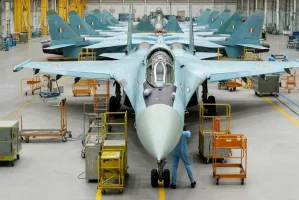
The Indian Air Force (IAF) is reportedly shifting its attention toward a more advanced version of Russia’s premier stealth fighter to address a temporary shortage in its fifth-generation aerial capabilities.
Sources indicate that New Delhi is exploring a potential government-to-government (G2G) agreement to acquire the Su-57M1E, a second-stage modernisation of the Sukhoi Su-57 platform.
A Pivot to the "Final Form"
This strategic shift suggests that India is bypassing the initial production models of the Su-57 in favour of the "M" variant, which represents the aircraft’s intended full-specification design.While earlier iterations of the fighter were viewed as technologically advanced, they faced criticism for design compromises, particularly regarding engine performance and rear-aspect stealth vulnerabilities.
The Su-57M1E is engineered to resolve these issues, featuring:
- Next-Generation Propulsion: New engines capable of sustained "supercruise" at speeds of Mach 1.6 without the need for afterburners.
- Enhanced Power: A 15–20% increase in thrust, improving the jet’s agility and acceleration during close-range engagements.
- Redesigned Stealth Features: New 2D or serrated exhaust nozzles and advanced composite materials aimed at significantly lowering the aircraft's radar and infrared signatures.
Digital Dominance and AI Integration
The modernised cockpit is a central feature of the M1E variant. It replaces traditional interfaces with a singular Wide-Area Display, simplifying the vast amount of data a pilot must process.Furthermore, an onboard artificial intelligence suite is designed to manage approximately 90% of routine flight operations.
This system autonomously handles sensor fusion and target prioritisation, allowing the pilot to focus solely on tactical decisions.
To complement this, a sophisticated helmet-mounted system provides 360-degree situational awareness, effectively allowing the pilot to see through the airframe.
Strategic Detection and Electronic Warfare
The aircraft’s N036 Byelka radar has been refined to be more resilient against electronic jamming.A unique tactical advantage remains its use of L-band radar arrays built into the wings.
While most stealth fighters are optimised to evade X-band fire-control radars, they remain more visible to L-band frequencies, providing the IAF with a potential tool to detect other low-observable threats in the region.
Procurement Strategy and Domestic Context
Current discussions suggest that India is prioritising an off-the-shelf purchase through a G2G framework rather than establishing local assembly lines.This approach is intended to accelerate the induction process, avoiding the long lead times required for domestic infrastructure and training.
| Feature | Baseline Su-57 | Su-57M1E Variant |
| Engine | Interim Powerplant | Next-Gen AL-51F1 |
| Supercruise | Limited/Dry Thrust Struggles | Approx. Mach 1.6 |
| Cockpit | Multiple Displays | Wide-Area Display & AI |
| Nozzle Design | Round / Exposed | 2D / Serrated (Stealthier) |
While these talks progress, India remains committed to its indigenous Advanced Medium Combat Aircraft (AMCA) programme.
Recent reports from early 2026 indicate that the AMCA project has entered a new phase, with private firms like Tata and L&T taking lead roles in prototype development to ensure a first flight by 2029.
Any potential acquisition of the Su-57M1E would serve as a bridge to maintain air superiority until the domestic defence programme reaches full maturity.