The Indian Air Force (IAF) is navigating a crucial period for its MiG-29UPG "Fulcrum" fighter jets.
As the military works to keep these aircraft combat-ready into the late 2030s, a major priority is eliminating reliance on fragile foreign supply chains.
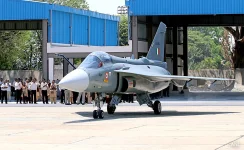
Rather than facing an early retirement, the IAF plans to maintain the MiG-29UPG fleet—which is actively deployed across key frontline bases such as Adampur and Srinagar—until the domestically built Tejas Mk2 fighter aircraft gradually takes over operations.
Domestic Push for Spares and Maintenance
To secure the fleet's future, the IAF has accelerated efforts to source maintenance and spare parts from local Indian companies.Moving away from traditional Russian suppliers, Air Headquarters has recently issued specific procurement drives for MiG-29UPG components.
Most notably, two major tenders for fleet spares (Tender IDs 2026_IAF_761000_1 and 2026_IAF_765252_1) are set to close in July and August 2026, marking a firm commitment to defence self-reliance.
Geopolitical tensions have heavily disrupted Russian defence exports, prompting India to turn to local industry to maintain its older aircraft.
The new maintenance strategies focus on integrating Indian micro, small, and medium enterprises (MSMEs), private aerospace companies, and domestic maintenance hubs like the one in Nagpur.
By producing essential parts—ranging from structural fasteners and seals to landing gear components—within India, the IAF hopes to resolve overseas supply bottlenecks and extend the operational life of the MiG-29UPG.
ASRAAM Integration Boosts Combat Power
The most significant combat enhancement for the MiG-29UPG is the addition of the European-designed Advanced Short Range Air-to-Air Missile (ASRAAM).Replacing the outdated Soviet-era R-73, the ASRAAM brings next-generation capabilities to the fleet.
While the older R-73 struggles to detect modern, low-heat targets like drones, the ASRAAM features a highly advanced imaging infrared seeker.
This makes it exceptionally capable of tracking and destroying small, low-signature aerial threats.
To further support this capability, Bharat Dynamics Limited (BDL) is establishing a facility in Hyderabad to assemble and maintain these missiles domestically.
The new missile dramatically increases the fighter's strike range.
Flying at speeds exceeding Mach 3, the ASRAAM can engage targets beyond 25 kilometres, effectively doubling the reach of the older system.
Crucially, it features "Lock-On After Launch" (LOAL) technology, allowing pilots to fire the missile toward a suspected enemy location before the radar has fully locked on.
The missile autonomously finds its target mid-flight, providing a rapid-response capability that turns the MiG-29UPG into a formidable defender against fast-moving drone swarms in contested airspace.
Indian Radars and Astra Missiles on the Horizon
Looking ahead, the IAF is exploring replacements for the aircraft's current Russian Zhuk-ME radar, which faces long-term thermal degradation and maintenance challenges.Indian firms like Data Patterns are developing scaled Active Electronically Scanned Array (AESA) radars, while the Defence Research and Development Organisation (DRDO) is considering a compact version of its Uttam radar for the fleet.
Transitioning to an Indian radar system is vital because it removes the software restrictions imposed by Russian technology.
Once free of these foreign source-code limitations, the IAF can seamlessly equip the MiG-29UPG with India's own Astra Mk1 and Mk2 Beyond-Visual-Range (BVR) missiles.
Currently operating over 50 of these upgraded airframes, the IAF is taking a highly practical approach.
By pursuing targeted modernisations, the military ensures its fighter squadrons remain a potent and fully independent defence force during the long transition toward the Tejas Mk2.