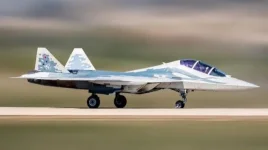
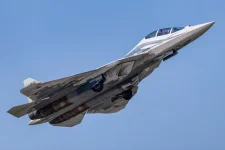
The recent maiden flight of the Su-57D, the newly unveiled twin-seat variant of Russia’s fifth-generation stealth fighter, has sparked significant interest within Indian defence communities.
Successfully test-flown by renowned pilot Sergei Bogdan on May 19, 2026, the jet is now only the second operational twin-seat fifth-generation fighter globally, trailing China’s J-20S.
For the Indian Air Force (IAF), which had firmly advocated for this specific two-crew design over a decade ago, the debut of the Su-57D represents the realisation of an operational concept that first took shape during the joint Fifth Generation Fighter Aircraft (FGFA) discussions.
During the initial FGFA negotiations in the early 2010s, India emerged as a pioneering voice pushing for a two-seat fifth-generation platform.
At the time, the IAF outlined a clear necessity for approximately 48 twin-seater variants to complement a larger planned fleet of single-seat jets.
Indian military planners envisioned the second crew member managing advanced electronic warfare systems, coordinating complex long-range strike missions, and facilitating the effective training of next-generation pilots.
In response to India's requirement, Moscow indicated that engineering a tandem-seat stealth fighter would require significant financial backing, asking New Delhi for roughly $4.5 to $5 billion to fund the design, prototyping, and certification phases.
While the broader FGFA collaboration ultimately stalled in 2018 over disagreements regarding stealth capabilities, technology transfer, and costs, India's unwavering demand for the twin-seat design demonstrated remarkable foresight.
The IAF understood early on that modern aerial combat would demand the flexibility of a two-crew aircraft to manage overwhelming data and high-threat environments.
The introduction of the Su-57D, developed independently by Russia over the past 16 years—reportedly by heavily modifying an older T-50-5 prototype—highlights the steep engineering challenges of adding a second seat without compromising stealth, supercruise speeds, or combat agility.
The aircraft's tandem cockpit layout provides crucial advantages on the modern battlefield.
A dedicated weapons systems officer in the rear seat can oversee network-centric warfare operations, process fused sensor data, and act as an airborne commander for loyal wingman drones like the Russian S-70 Okhotnik, allowing the front pilot to focus entirely on flight and direct combat.
New Delhi's forward-thinking approach during the early FGFA talks undoubtedly helped validate the global necessity for a two-seat Su-57.
Even after the joint programme dissolved, Russian engineers continued to refine the concept, clearly influenced by India's original specifications.
The IAF's initial proposal to acquire nearly fifty of these jets highlighted a strategic ambition to build a versatile combat fleet, perfectly balanced between advanced operational readiness and comprehensive pilot training capabilities.
The official confirmation and recent imagery of the Su-57D have reignited conversations among Indian defence experts regarding potential future acquisitions.
As the IAF navigates an urgent modernisation drive and awaits the arrival of the indigenous Advanced Medium Combat Aircraft (AMCA) in the next decade, a mature, twin-seat fifth-generation platform offers an intriguing interim solution.
Consequently, the availability of the Su-57D might pave the way for renewed aerospace cooperation between New Delhi and Moscow.
Ultimately, the successful flight of the Su-57D significantly bolsters Russia's standing in the global arms market while offering India a ready-made platform that mirrors its historical requirements.
Currently, only China and Russia possess the capability to produce twin-seat fifth-generation fighters.
As regional security dynamics shift—particularly with the rapid expansion of China's stealth fleet and Pakistan's pursuit of similar technologies—the Indian Air Force is uniquely positioned to evaluate how this new Russian development might fit into its long-term defence procurement strategy.