- Views: 2K
- Replies: 7
Indonesia is on the verge of officially securing a landmark procurement of the BrahMos supersonic cruise missile from India.
Recent statements from the Indonesian Ministry of Defence indicate that negotiations are effectively complete, paving the way for a formal contract signing expected early in the upcoming 2026–2027 fiscal year.
Valued at an estimated $300 million to $350 million, this acquisition focuses on the coastal defence variant of the formidable weapon system.
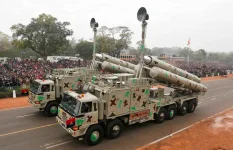
The preliminary framework of the agreement outlines the delivery of at least one shore-based BrahMos battery to Jakarta.
This initial procurement is designed to be scalable, allowing Indonesia to expand its arsenal in subsequent phases based on future military budgets and strategic needs.
Once the paperwork is finalised, Indonesia will become the second Southeast Asian nation to operate the system, following the Philippines' historic $375 million purchase in 2022.
This move significantly cements New Delhi's rising status as a major defence exporter in the Indo-Pacific region.
The Indo-Russian Supersonic Powerhouse
Produced by BrahMos Aerospace—a strategic joint venture between India’s Defence Research and Development Organisation (DRDO) and Russia’s NPO Mashinostroyenia—the missile is globally recognised as the fastest operational supersonic cruise missile.- Speed: Travels at velocities between Mach 2.8 and 3.0.
- Versatility: Capable of executing high-precision strikes against both maritime and land-based targets.
- Range: The export variant maintains a strike radius of approximately 290 kilometres.
Strategic Deterrence in the North Natuna Sea
Jakarta’s push to integrate the BrahMos system is a direct response to the urgent need for robust coastal defence across its expansive archipelago.The weapon will provide critical deterrence in vulnerable maritime chokepoints, particularly around the strategically vital North Natuna Sea.
In recent years, this energy-rich exclusive economic zone has been a flashpoint for tensions, with China repeatedly asserting overlapping territorial claims based on its expansive maritime boundaries.
Anatomy of a Coastal Defence Battery
To understand the tactical advantage Indonesia is purchasing, it helps to break down the integrated components of a standard BrahMos coastal defence battery, which mirrors the setup currently operated by the Philippine Marines:| Component | Function |
|---|---|
| Mobile Launchers | Two to three launcher vehicles, each equipped with multiple ready-to-fire missiles. |
| Command & Control | A central hub that coordinates communication, targeting data, and launch authorisations. |
| Radar Systems | Advanced sensors designed to detect, identify, and track hostile naval vessels at long ranges. |
| Support Vehicles | Transporter Erector Launchers (TELs) and specialised reload units for rapid rearming. |
In a standard deployment, a single battery maintains between 8 and 12 missiles in a ready-to-launch state, backed by additional stockpiles to ensure sustained operational tempo during a conflict.
A Layered Shield
By acquiring the BrahMos, Indonesia is equipping itself with a highly survivable, long-range anti-ship capability. The missile's sheer velocity drastically cuts down the window of time adversaries have to react.Furthermore, its capacity to skim the sea surface at low altitudes and execute complex terminal manoeuvres makes it incredibly difficult for modern naval defence shields to intercept.
Ultimately, this procurement represents a major leap in Indonesia's military modernisation, transforming its shores into a formidable barrier against encroaching naval threats.