India's defence planners are currently standing at a critical juncture regarding the future of the nation's aerial combat capabilities.
They must decide whether to merge the Indian Air Force's (IAF) Advanced Medium Combat Aircraft (AMCA) and the Indian Navy's Twin Engine Deck Based Fighter (TEDBF) into a unified family of aircraft, or continue on separate paths.
Experts caution that maintaining distinct development tracks could allow foreign acquisitions, such as the proposed massive procurement of 114 Multi-Role Fighter Aircraft (MRFA), to overshadow indigenous projects.
This scenario would mirror past situations where domestic innovation was sidelined by urgent imports.
A unified approach is increasingly viewed as essential, particularly as the military looks toward future platforms like next-generation nuclear-powered aircraft carriers equipped with Electromagnetic Aircraft Launch Systems (EMALS).
The AMCA represents India's premier fifth-generation stealth fighter initiative.
Upgraded to a 25-tonne weight class, the aircraft is designed for deep-penetration strikes with features like internal weapons bays, supercruise capabilities, and AI-driven avionics.
Recent engineering milestones, such as the Aeronautical Development Agency (ADA) validating an S-duct intake design that achieves an exceptional 98% pressure recovery, highlight its rapid progress toward a projected first flight in 2028 and mass production by the mid-2030s.
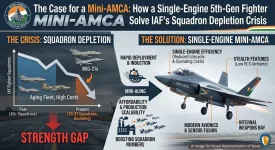
This timeline is vital for the IAF, which currently operates around 31 fighter squadrons—well below the sanctioned strength of 42—and faces further depletions with the phasing out of older jets.
In parallel, the TEDBF is a dedicated maritime fighter intended for carriers like the INS Vikrant.
While it shares advanced avionics with the AMCA, it incorporates naval-specific modifications such as folding wings and strengthened landing gear for carrier deck operations.
The ADA finalized the TEDBF's aerodynamic configuration in April 2026, shifting the focus toward rigorous wind-tunnel testing, though its first flight is now expected closer to the 2030-2032 timeframe.
Running these two advanced fighter programmes concurrently places a heavy burden on India's defence budget.
Separate research and development efforts duplicate work, strain funding, and stretch the domestic aerospace supply chain.
To resolve this, military leaders, including former Navy Chief Admiral Arun Prakash, are strongly advocating for a consolidated "Naval-AMCA" (N-AMCA) model.
This strategy would establish a Joint Service Qualitative Requirement (JSQR) to bridge the needs of both the IAF and the Navy.
By adapting the AMCA's stealth airframe for carrier operations and sharing powerplants—initially the GE F-414 and eventually an indigenous 110-120 kN engine—development costs could be reduced by an estimated 30 to 40 percent.
This unified framework mirrors successful international models, such as the American F-35 programme, which developed land, maritime, and vertical-lift variants from a single core design.
A successful merger, however, must extend beyond the fighter jets themselves to include a comprehensive combat ecosystem.
The Indian Navy's long-term vision includes acquiring a 65,000 to 75,000-tonne next-generation aircraft carrier (IAC-III) equipped with EMALS, replacing traditional ski-jump ramps to allow for heavier payloads and seamless drone launches.
Supporting this, the Defence Research and Development Organisation (DRDO) recently developed a scaled-down technology demonstrator of an Electro-Magnetic Launch System (EMLS), paving the way for full-scale domestic catapults.
Furthermore, future aerial warfare will rely heavily on Manned-Unmanned Teaming (MUM-T).
By integrating unmanned combat aerial vehicles (UCAVs) like Hindustan Aeronautics Limited's (HAL) CATS Warrior and NewSpace's Abhimanyu, N-AMCA pilots could command drone swarms directly from the cockpit for reconnaissance and strike missions.
This synergy would significantly multiply India's force projection capabilities across the Indo-Pacific region without needing to vastly expand manned fleets.
The urgency of this consolidation is underscored by the historical challenges faced during the Light Combat Aircraft (LCA) Tejas programme.
Chronic delays, primarily caused by foreign engine supply bottlenecks and production limitations, resulted in a slow induction rate over four decades.
To address immediate operational gaps, the government imported 36 Rafale fighters in 2016.
Today, there are concerns that a massive $24.5 billion procurement for 114 foreign fighters could similarly divert crucial funding and urgency away from indigenous projects like the AMCA and Tejas Mk2.
Observers warn that off-the-shelf imports perpetuate technological dependency and cost significantly more per unit than homegrown alternatives.
Supporters of the combined N-AMCA project argue that establishing a single Special Purpose Vehicle (SPV) to manage development would drastically streamline the process.
Not only could this strategy cut project timelines in half, but it would also firmly align with the government's Atmanirbhar Bharat initiative by targeting a 70% indigenisation rate.
Ultimately, a highly capable, cost-effective, and unified fighter family could transform India from an importer of combat aircraft to a competitive exporter on the global stage.