- Views: 2K
- Replies: 1
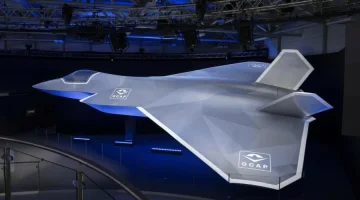
The Global Combat Air Programme (GCAP)—the joint sixth-generation stealth fighter project uniting the United Kingdom, Japan, and Italy—is navigating a highly turbulent phase.
While initially forged as a tightly knit trilateral alliance, the ambitious initiative is now grappling with funding bottlenecks, differing strategic goals, and a widening search for new partners, notably India.
These hurdles increasingly threaten the consortium's target of delivering an operational, combat-ready aircraft by 2035.
At the heart of this endeavour is Edgewing, an industrial joint venture established in 2025 by major defence contractors BAE Systems, Leonardo, and Mitsubishi Heavy Industries.
Merging the British Tempest and Japanese F-X initiatives, Edgewing operates as the central authority for the aircraft's design and engineering. Their roadmap demands a flying demonstrator by 2027, paving the way for the mid-2030s rollout.
Progress, however, has stalled significantly due to fiscal hesitations in London. The UK's highly anticipated Defence Investment Plan, which is critical for releasing multi-billion-pound funding for the next phase of full-scale engineering, remains repeatedly postponed due to domestic budget shortfalls.
Consequently, the crucial development contract between Edgewing and the GCAP International Government Organisation (GIGO) is currently frozen, sparking widespread anxiety among the partner nations.
This bureaucratic delay is particularly alarming for Japan, which views the GCAP as an existential defence priority.
Tokyo's timeline is non-negotiable: it urgently requires a next-generation fighter by the mid-2030s to maintain parity with China's rapid aerospace advancements, notably the ongoing flight-testing of Beijing's J-36 and J-50 sixth-generation prototypes.
For the Japanese Ministry of Defence, British budgetary stalling translates directly into a looming capability gap in the highly contested Indo-Pacific.
Beyond financial friction, a distinct gap in strategic philosophy has emerged.
The UK and Italy maintain a more flexible outlook, viewing the GCAP as a complex "system of systems"—a manned jet operating seamlessly alongside autonomous drone swarms—developed over a longer, adaptable timeline.
Conversely, Japan remains rigidly focused on acquiring a deployable fighter jet on a strict schedule. This mismatch is translating into notable friction at both the industrial and governmental levels.
Compounding these challenges is the astronomical price tag, which has reportedly tripled since the programme's conception. To alleviate this severe fiscal strain, Japan is recalibrating its traditionally strict stance on collaboration and technology transfer.
Tokyo is now actively exploring the inclusion of new international partners capable of injecting crucial capital and sharing the immense developmental burden.
This shift in policy has attracted several prospective members. Although Japan previously blocked Saudi Arabia's bid to join due to technology transfer concerns and export policies, the door is now opening for others.
Poland, for instance, has officially initiated talks, expressing a strong desire to integrate into the GCAP's industrial supply chain and contribute to the broader ecosystem.
London shares this renewed appetite for expansion. British Defence Secretary John Healey has publicly affirmed that the core partners are receptive to welcoming new nations, provided they bring tangible value without derailing the current schedule.
This pragmatic approach underscores the reality that developing a sixth-generation platform requires vast, multinational cost-sharing.
Most notably, India has surfaced as a formidable prospective partner.
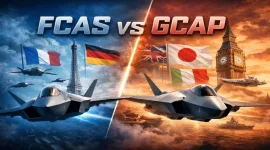
In March 2026, India's Chief of Defence Staff informed a parliamentary committee that the Indian Air Force is actively exploring membership in either the GCAP or the rival European Future Combat Air System (FCAS).
Driven by the need to counter regional threats and avoid falling behind in next-generation air combat technologies, New Delhi is evaluating its options. Japanese officials have already conducted detailed briefings to entice Indian participation.
Despite this interest, the exact nature of India's potential involvement is still undefined. It remains unclear whether New Delhi will pursue a comprehensive co-development role—requiring deep workshare, technology transfer, and source-code access—or settle for a future procurement arrangement.
Furthermore, India must carefully balance any foreign partnership with its domestic Advanced Medium Combat Aircraft (AMCA) programme, which is currently slating its first prototype flight for around 2029.
The GCAP's shifting landscape is also influenced by broader European defence politics.
Germany, currently a key player in the competing FCAS programme alongside France and Spain, is reportedly evaluating the GCAP due to ongoing industrial disputes over leadership and workshare within its own consortium.
Recent outreach from German Chancellor Friedrich Merz to Italian officials highlights the fluid and highly competitive nature of next-generation fighter alliances.
Ultimately, the GCAP stands at a critical juncture. British financial delays have sparked serious doubts about the programme's timelines, while Japan's strategic urgency forces a push for rapid resolutions and broader coalition-building.
However, the active interest from heavyweights like India, Poland, and potentially Germany cements the GCAP's position as a highly sought-after, geopolitically vital asset in the future of global air superiority.