India's pursuit of a homegrown fifth-generation stealth fighter is approaching a critical milestone.
By next month, the government is poised to release a formal Request for Proposal (RFP) to three pre-selected, private sector-driven industrial groups vying to build the Advanced Medium Combat Aircraft (AMCA).
Defence Secretary Rajesh Kumar Singh verified this timeline on Tuesday during a Confederation of Indian Industry summit in New Delhi focused on strategic resilience and supply chains.
This progress follows the crucial Cabinet Committee on Security (CCS) approval granted in March 2024, which sanctioned roughly ₹15,000 crore for the prototype development phase.
The upcoming RFP will require the shortlisted groups to submit comprehensive commercial and technical blueprints for manufacturing the AMCA.
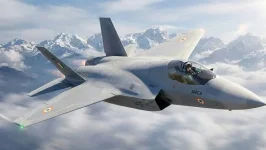
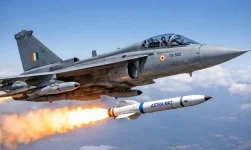
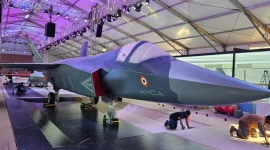
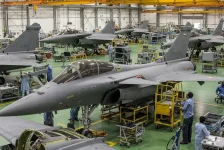
Designed by the Aeronautical Development Agency (ADA), the AMCA is envisioned as the core of the Indian Air Force’s future strike capabilities, complementing the Rafale and upcoming Tejas Mk-2 fleets.
It stands as one of the nation's most vital aerospace endeavours, promising a highly networked, multirole fighter equipped with radar-evading stealth geometry, advanced sensor fusion, and internal weapons bays.
Highlighting a massive transformation in India's defence aerospace sector, Defence Secretary Singh noted that the selection process successfully yielded three strong, privately-led competitors.
Two of these teams represent a hybrid of private and public sector expertise, while the third is purely a private venture.
The final contenders are Larsen & Toubro working alongside Bharat Electronics Limited (BEL) and Dynamatic Technologies; Bharat Forge teaming up with BEML and Data Patterns; and Tata Advanced Systems Limited, which has entered the fray with an independent proposal.
The presence of these private consortia for a top-tier fighter programme represents a historic pivot away from the longstanding state-run monopoly held by Hindustan Aeronautics Limited (HAL).
Under a new Special Purpose Vehicle (SPV) model, the selected private partner will likely hold a majority stake and manage production, working closely with the ADA.
According to Singh, the government's objective is to establish a second, parallel fighter production line entirely separate from HAL.
This dual-ecosystem strategy is designed to foster healthy competition, boost manufacturing volume, improve delivery timelines, and create a deeper, more resilient industrial base for future military needs.
While HAL has been the bedrock of Indian aviation, the state-owned giant was reportedly disqualified during the financial assessment phase of the AMCA bidding.
Officials reportedly expressed deep concerns over HAL’s operational bandwidth, given that its current order backlog is nearly eight times its annual revenue.
Furthermore, HAL is currently grappling with severe delays on the Tejas Mk-1A project, where deliveries have been pushed back to mid-2026.
These bottlenecks have been largely attributed to supply chain issues and a shortfall in F404 engine deliveries from American manufacturer GE Aerospace.
Once the three teams meet the stringent technical benchmarks, the final contract is expected to be awarded based on the L1 (lowest bidder) principle.
This approach contrasts with recent drone procurements that weighed both cost and quality simultaneously.
By making price the ultimate deciding factor post-qualification, the government is driving the consortia to fiercely optimise their supply chains and manufacturing strategies to present the most aggressive and cost-effective bids possible.
The AMCA thrusts India into an exclusive club of countries capable of fielding fifth-generation aircraft.
The jet will boast supercruise capabilities—allowing it to sustain supersonic speeds without fuel-heavy afterburners—alongside low-observable geometry and cutting-edge avionics.
The initial batch of AMCA Mk1 fighters will be powered by American GE F-414 engines.
However, future Mk2 variants will rely on a customized 110-130 kilonewton class engine.
This advanced powerplant is currently the subject of intense negotiations for co-development and full technology transfer with global aerospace leaders like France's Safran and Britain's Rolls-Royce.
Beyond aviation, the Defence Secretary also signalled a monumental shift in the country's missile manufacturing strategy.
Historically, ballistic missile production has been the exclusive domain of state entities like Bharat Dynamics Limited (BDL).
However, Singh indicated that the government is now prepared to transfer critical ballistic missile technology to private firms.
Noting that modern conflicts increasingly rely on missiles as high-volume conventional weapons, he stressed that opening this sector is essential to rapidly scale up production and secure the nation's wartime supply chains.
These upcoming policy and procurement changes underscore New Delhi's determination to aggressively diversify and privatise its most sensitive defence sectors.
By empowering private industry to take the lead on both fifth-generation stealth fighters and strategic ballistic missiles, the government aims to dramatically reduce its reliance on a handful of public sector units and cultivate a robust, globally competitive domestic military-industrial complex.