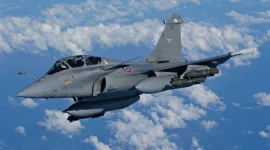
In a strategic shift aimed at enhancing military self-reliance, the Indian government is reportedly focusing on securing access to the Interface Control Document (ICD) for the Rafale fighter jet rather than demanding its highly sensitive core mission source code.
This decision is expected to play a pivotal role in the upcoming procurement of 114 Multi-Role Fighter Aircraft (MRFA), a project often referred to as the "mother of all defence deals."
Strategic Autonomy Through Technical Access
Defence Secretary Rajesh Kumar Singh recently suggested that gaining ICD access would meet nearly all of India's operational needs.While the core source code acts as the "brain" of the aircraft—governing flight controls and proprietary algorithms—the ICD serves as the "handshake" protocol.
It defines the technical parameters required for external systems to communicate with the aircraft’s mission computer.
By securing this access, India can independently integrate its growing library of indigenous weaponry without needing constant technical intervention or "speed dial" support from the French manufacturer, Dassault Aviation.
| Feature | Core Source Code | Interface Control Document (ICD) |
|---|---|---|
| Function | Controls foundational flight and mission logic. | Defines how external hardware talks to the jet. |
| Sovereignty | Full control over every software bit. | Autonomy in weapon and sensor integration. |
| Availability | Rarely shared by global manufacturers. | More commonly negotiated in export deals. |
| Impact | Allows modification of radar/EW logic. | Allows seamless use of indigenous missiles. |
Boosting the "Make in India" Initiative
The move is particularly critical as India plans to manufacture approximately 90 of the 114 Rafale jets domestically through a collaboration between Dassault and Indian partners like Hindustan Aeronautics Limited (HAL).With ICD-level access, Indian engineers and DRDO scientists can independently test, validate, and certify homegrown systems on the Rafale platform.
This significantly reduces the "integration tax"—the high fees and long timelines typically associated with asking a foreign manufacturer to certify a new weapon.
Integration of Indigenous Arsenals
Open-source data indicates that India intends to equip the Rafale fleet with a variety of advanced, locally-developed munitions, including:- Astra Series: Beyond-Visual-Range (BVR) air-to-air missiles (Mk1, Mk2, and Mk3).
- Rudram: Anti-radiation missiles designed to destroy enemy radar installations.
- SAAW: Smart Anti-Airfield Weapons for precision strikes on ground infrastructure.
- BrahMos-NG: A lighter, next-generation version of the supersonic cruise missile.
Conclusion
While full source code remains the ultimate prize in aerospace diplomacy, ICD access offers a pragmatic middle ground.It protects the intellectual property of France while granting the Indian Air Force the flexibility to evolve its combat capabilities.
This approach ensures that the Rafale remains a potent, "sovereign" asset capable of adapting to regional threats without being tethered to foreign approval cycles.