India Shifts Naval Focus Towards Hybrid Aircraft Carriers with Advanced Drone Swarm Capabilities as IAC-2 Approval Nears

India Shifts Naval Focus Towards Hybrid Aircraft Carriers with Advanced Drone Swarm Capabilities as IAC-2 Approval Nears


The Indian Navy is currently navigating a crucial transition in its maritime strategy, opting for practical combat readiness over sheer size.

As the Ministry of Defence prepares to potentially approve the second Indigenous Aircraft Carrier (IAC-2) in 2026, planners have moved away from the idea of a massive 65,000-tonne supercarrier. Instead, the focus has pivoted towards a versatile, hybrid aviation platform.

This new approach embraces modern combat philosophies, prioritising drone integration, scattered firepower, and adaptable sea command over a single, monolithic vessel.

Consequently, the proposed IAC-2 will not be a simple replica of its predecessor, INS Vikrant. The ship's core design is undergoing major revisions to heavily incorporate unmanned technology.

Modifications to the flight deck are underway to ensure that swarms of drones can be launched and recovered seamlessly alongside traditional piloted jets.

A key element of this upgrade is the inclusion of the 'Abhimanyu' drone—a jet-powered, stealthy "loyal wingman" developed under the Naval Collaborative Combat Air Vehicle (N-CCAV) programme by Bangalore-based NewSpace Research & Technologies.

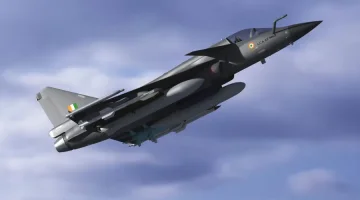
Designed to fly alongside crewed fighters like the MiG-29K and the upcoming Rafale-M, these advanced unmanned aerial vehicles (UAVs) will allow the carrier to function as a central command hub for a complex network of airborne, surface, and underwater drones.

Ultimately, this evolution highlights a departure from conventional carrier strike group tactics.

The Navy is shifting its focus towards highly connected maritime battle networks, where the primary advantages are information superiority and dispersed offensive capabilities rather than relying purely on traditional fighter launches.

The Argument for a Massive Supercarrier​

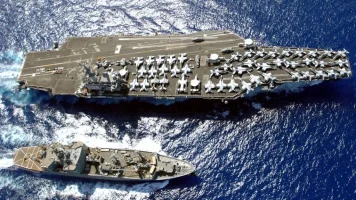
The original concept of building a 65,000-tonne supercarrier still holds strategic appeal. A vessel of that magnitude would provide overwhelming air superiority, accommodate a much larger fleet of aircraft, and sustain longer deployments deep into hostile territories.

For projecting power far beyond India's immediate coastal waters and deterring major rivals across the broader Indo-Pacific, a supercarrier would offer an unparalleled physical presence and formidable strike options.

Despite these advantages, the immense financial and industrial resources required for such a mammoth project are daunting. Building a supercarrier would dramatically stretch construction schedules.

Furthermore, relying on one extremely expensive, high-value asset as the core of naval deterrence creates significant strategic vulnerabilities if the vessel were to be targeted.

Recent developments indicate that the government is instead poised to grant the Acceptance of Necessity (AoN) this year for a 45,000-tonne carrier.

Expected to be constructed by Cochin Shipyard Limited (CSL), this vessel will largely mirror the displacement of the INS Vikrant but will feature extensive deck adaptations for drone operations and preparations for potential Catapult Assisted Take-Off But Arrested Recovery (CATOBAR) systems.

This pragmatic decision bridges the gap between grand ambitions and operational reality.

By capitalising on an already proven hull design, the Navy can significantly speed up the delivery process, control the budget, and continue to foster local shipbuilding skills—advancing domestic defence manufacturing—without straining the nation's industrial capacity.
 
Aircraft carriers in modern warfare heavily need stealth fighters.
Hope the IAC-2 is able to carry multiple units of stealth unmanned jets like Ghatak....which can be the force to deal with.
 
Supercarriers are less useful and more of a financial and strategic liability in today's age. Especially for a geography like the Indian Ocean, smaller nuclear carriers with hybrid capabilities are far more suited. Unlike the US, We need security not invasion forces.
 
We should develop high tech stealthy drones, AI operated fighter jets and sea submarine drones like small kamikazi drones those can move fast and can be hidden deep in the sea. We need one or two carriers but we needs weapons as well as delivery system those can evade enemies defense systems.
 
Well the fact that aircraft carriers are a must when it comes to defending your strategic interests beyond just our own coasts china has three carriers and they are building more soon we will have capacities of drone interceptions as well that tactic isn't gonna remain for long if anyone can remember Russia couldn't defend its shadow fleet of oil near Venezuela only cause it didn't had a strike group that could operate that far we need those if we don't want ourselves bullied around
 
It's a good idea to get smaller carriers that are more versatile, adaptable and agile, than a supercarrier... The recent wars prove it good in Iran as 2 US supercarriers with firepowers more than 70% of country's armed forces, can do much of damage, instead they need to be heavily guarded, can't launch the jets as there is no confirmed air superiority and extremely fatigued crew, all totalling to being useless after 2 weeks even with reactors powering them to last 20 years on sea. Better is a drone capable carrier, infact perhaps 2 to 3 smaller carriers than one supercarrier, with excellent strike groups full with frigates and subs is what defines the future. And glad that Indian decision makers have seen that prospect and is working with that in consideration.
 
It's a good idea to get smaller carriers that are more versatile, adaptable and agile, than a supercarrier... The recent wars prove it good in Iran as 2 US supercarriers with firepowers more than 70% of country's armed forces, can do much of damage, instead they need to be heavily guarded, can't launch the jets as there is no confirmed air superiority and extremely fatigued crew, all totalling to being useless after 2 weeks even with reactors powering them to last 20 years on sea. Better is a drone capable carrier, infact perhaps 2 to 3 smaller carriers than one supercarrier, with excellent strike groups full with frigates and subs is what defines the future. And glad that Indian decision makers have seen that prospect and is working with that in consideration.
Quite agreed 2 or 3 smaller carriers maybe even more a subtle quantity with superior tech is enough but I would say that any consideration with Iran and US engagement can lead to a fallacy that supercarriers are a burden as Iran used it's strategic strait and shallow water to cause problems for US we have deeper waters and a large maritime security reach in the Indian Ocean to take care off any engagement here would be much different also United States has showcased strategic underestimation and complacency regarding using the carrier tactics they thought that brute force would be enough just like Russia did four years back with Ukraine
 

Forum statistics

Threads
6,665
Messages
63,939
Members
5,085
Latest member
rishisingh
Back
Top