- Views: 2K
- Replies: 1
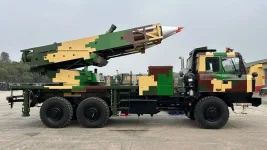
India's push to upgrade its artillery firepower has taken a major step forward with the rapid induction of the Suryastra rocket system.
Rooted in the advanced PULS (Precise and Universal Launching System) technology from Israel's Elbit Systems, the platform was cleared for immediate service after showcasing impressive accuracy and adaptability during pre-contract testing.
To bring this capability into the field quickly, the Indian Army executed a ₹293 crore emergency procurement contract with Pune-based NIBE Limited and its Israeli technology partner.
This fast-track acquisition highlights the military's pressing need to bolster its long-range precision strike capabilities in the face of rapidly evolving threats along its borders.
The system, mounted on a highly mobile 6x6 Tatra truck, recently made its public debut at the Republic Day Parade, officially marking its entry into India's strategic arsenal.
A major factor in bypassing the usual, lengthy procurement process was the system's remarkable accuracy.
During trials, the Suryastra achieved a Circular Error Probable (CEP) of less than five meters.
This means the rockets can consistently hit within five meters of their intended targets, transforming what is typically an area-bombardment weapon into a tool capable of near-surgical strikes against high-value assets.
Furthermore, the Suryastra offers unmatched operational flexibility through its multi-calibre design.
Instead of being limited to a single type of ammunition, it uses interchangeable modular pods that can fire a variety of munitions.
This includes 122mm rockets for closer engagements, 306mm EXTRA missiles capable of hitting targets at 150 kilometres, and 370mm Predator Hawk missiles that can reach up to 300 kilometres.
Consequently, field commanders can seamlessly shift from broad saturation attacks to deep, pinpoint strikes from a single launcher.
This immediate 300-kilometre range gives the Indian Army a substantial advantage, allowing it to neutralize enemy infrastructure far beyond the frontlines.
This effectively serves as a critical stop-gap measure while domestic systems, like the extended-range Pinaka-ER, are still maturing. In contrast to the Pinaka, which is currently limited to specific calibres, the Suryastra’s modularity provides a much broader spectrum of strike options right now.
Adding a modern edge to its capabilities, the system can also launch SkyStriker loitering munitions—often referred to as suicide drones.
Capable of traveling up to 100 kilometres, these drones allow the launcher to perform both direct kinetic hits and opportunistic loitering attacks, making it highly effective in dynamic and unpredictable combat environments.
The first two launchers and a loader vehicle have already been handed over to the Army and are currently undergoing final live-fire validation.
Ultimately, the induction of the Suryastra acts as a vital counterbalance to regional artillery advancements, such as Pakistan’s 400-kilometre range Fatah-II guided rocket and China’s PHL-16, which can strike targets up to 500 kilometres away.
By ensuring deep-fire parity in the near term, the Suryastra strengthens India’s deterrence posture and operational readiness, and its impressive performance may well secure it a permanent role within the nation's defence framework.