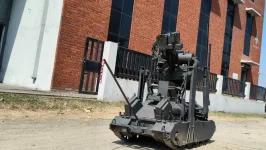
The landscape of military startups in India is rapidly expanding. Recently, Vadodara-based Svaayatt Systems Private Limited revealed the creation of the SGV-500 Scorpion, an unmanned ground vehicle (UGV) capable of navigating multiple types of terrain.
The firm is currently gearing up to present a live technical showcase to the Indian Armed Forces. This demonstration will highlight the combat-ready robotic platform, which comes equipped with weapons and is built to assist in active frontline operations.
Svaayatt Systems, an emerging player in the Indian aerospace and defence manufacturing sector, specialises in AI-driven autonomous navigation, adding significant indigenous technical weight to this development.
This upcoming showcase is a major step forward, moving the SGV-500 from the research and development phase into a practically tested machine ready for actual battlefield use.
The rigorous trials will specifically test how well the vehicle integrates with its onboard weaponry and how it moves across difficult landscapes.
Furthermore, the tests will evaluate the dependability of its communication links and its ability to strike targets accurately while being steered from a distance.
Fundamentally, the SGV-500 functions as a small but heavily armed tracked robot, built for intense warfare situations. Its primary duties include providing covering fire, conducting reconnaissance, strengthening perimeter defence, and attacking opposing foot soldiers or lightly armoured vehicles.
Official technical documents outline that the machine was created to function in dangerous conflict zones, thereby keeping human troops out of direct harm's way.
During the live trials, the UGV will fire real ammunition using attached arms like grenade launchers and light machine guns.
The technology is programmed to spot and lock onto targets swiftly, taking less than three seconds to react, with an accuracy level that rivals standard manual operation.
These exercises aim to prove that the robotic unit can successfully and safely unleash accurate firepower from afar, a tactical necessity in today's military conflicts.
Movement capability remains another vital testing point. The platform is constructed to travel over uneven ground, ascend hills, and operate continuously over long stretches.
It aims to prove it can cover more than 40 kilometres on a single charge while handling steep inclines during active duty. Because of its tank-like tracks and relatively small size, the SGV-500 can smoothly navigate tight areas, making it highly effective for city combat and narrow alleys.
Looking at the specifications, the machine weighs roughly 500 kilogrammes and is heavily shielded with protective plating to ensure it survives enemy fire. It can travel at speeds reaching 30 kilometres per hour.
Operators can maintain direct control from up to 10 kilometres away, though this operational reach can be vastly expanded if aerial drones are used to bounce the control signals further.
A particularly unique aspect of the Scorpion is its deeply engaging remote control setup. The interface utilises virtual reality technology, allowing the user to simply turn their head to shift the robot's cameras and aim its weapons.
This setup provides a natural, first-person view of the battlefield, which greatly sharpens the operator's awareness and aiming precision during fast-paced encounters.
Additionally, the UGV boasts a flexible design that lets it adapt to various types of missions. It is not limited strictly to fighting; it can be quickly reconfigured to transport military supplies, rescue injured soldiers, fight fires, or launch smaller drones into the air.
This versatility makes the SGV-500 an invaluable asset for a wide range of standard and specialised military tasks.
The trials will also critically test the strength and security of the machine's communication systems. Maintaining an unbreakable link between the robot and its controller is essential, especially in areas where enemy forces might try to jam or disrupt electronic signals using advanced warfare tactics.
Creating this robotic platform highlights a global trend in military strategy, which is rapidly moving towards using unmanned and partially automated machinery.
As armies around the globe begin relying on ground robots for their most dangerous tasks, locally built models like the SGV-500 give India clear benefits. These include reduced expenses, easier modifications, and complete independence from foreign defence suppliers.
For India's military, incorporating these technologies could completely change the way they handle border security, anti-terrorist activities, and city-based conflicts.
Using robotic vehicles to scout areas and attack targets means troops face far fewer direct dangers, all without losing any tactical edge on the ground.
Ultimately, this forthcoming live test serves as a defining event for Svaayatt Systems. Should the UGV pass these evaluations, it could lead to official military adoption, more advanced testing, and the widespread use of home-grown unmanned ground vehicles throughout India's national defence network.