- Views: 2K
- Replies: 4
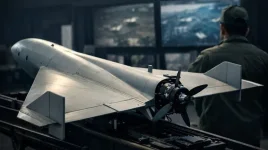
Recent technical assessments and visual data have unveiled a significant contrast in the engineering and strategic philosophies of two prominent loitering munitions: the Iranian Shahed-136 and India's emerging Sheshnaag-150.
Although both aircraft utilize a delta-wing shape common to long-distance attack drones, their specific structural designs, engine types, and intended roles on the battlefield demonstrate two very different approaches to modern defence technology.
Structural Engineering and Aerodynamics
While both drones utilize delta wings for high efficiency and endurance, their control systems are distinct. The Shahed-136 features vertical rudders positioned at the wingtips, which provide stability but add to the airframe's external complexity.In contrast, the Sheshnaag-150, developed by Bengaluru-based NewSpace Research Technologies (NRT), employs a single central fin on the fuselage. This modification streamlines the wings and simplifies the manufacturing process, allowing for faster production.
Materials used in construction also highlight different priorities:
- Shahed-136: Uses carbon fiber and honeycomb composites to maintain a low weight and reduce radar visibility.
- Sheshnaag-150: Focuses on a low-aspect-ratio wing designed to maximize internal fuel capacity, prioritizing long-duration missions and mass manufacturability.
Propulsion and Performance
The two systems operate on different power philosophies to achieve their long-range goals:| Feature | Shahed-136 | Sheshnaag-150 |
|---|---|---|
| Engine Type | 50-hp four-cylinder piston (MD-550) | Compact Rotary or Piston engine |
| Endurance | High (Varies by load) | 5+ Hours |
| Operational Range | 1,000 – 2,500 km | 1,000+ km |
| Payload Capacity | 40 – 50 kg | 25 – 40 kg |
The Shahed-136 is designed as a low-cost, high-volume weapon for mass deployment.
The Sheshnaag-150, while similarly long-ranged, emphasizes mission flexibility and has recently been showcased at the World Defence Show 2026 as a precision-strike alternative to expensive cruise missiles.
Operational Doctrine: Saturation vs. Intelligence
The most striking difference lies in how these drones are used in combat.The Shahed-136 is an attritional tool; it relies on overwhelming enemy defence systems through sheer numbers. It uses standard satellite navigation (GPS/GLONASS) to follow a set path toward a fixed target.
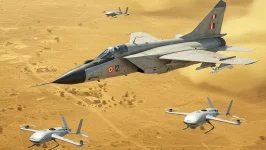
Conversely, the Sheshnaag-150 is built for networked swarming.
It utilizes AI-driven logic and mesh networking, allowing a group of drones to communicate and coordinate during flight. This creates a "self-healing" network where, if one drone is destroyed, others automatically reassign targets to ensure the mission's success.
Navigation in Contested Environments
To counter electronic warfare, the Sheshnaag-150 integrates advanced visual navigation systems. This allows the drone to navigate using terrain recognition when satellite signals are jammed—a capability the Shahed-136 generally lacks.Because of this high-tech guidance, the Sheshnaag-150 targets a Circular Error Probable (CEP) of just five metres, bringing it closer to the accuracy levels of guided missiles than traditional suicide drones.
Modular Future
The Shahed-136 is a single-purpose, one-way attack weapon. The Sheshnaag-150 is designed with a modular architecture, meaning it can be reconfigured for different roles, such as:- ISR: Intelligence, Surveillance, and Reconnaissance.
- EW: Electronic Warfare and signal jamming.
- Kinetic Strike: High-precision explosives.