- Views: 2K
- Replies: 4
In a major leap for India’s strategic capabilities, the Defence Research and Development Organisation (DRDO) reportedly achieved a crucial breakthrough with the successful "pop-up" ejection trial of the next-generation K-5 Submarine-Launched Ballistic Missile (SLBM).
Conducted in the final week of March, this critical test marks a significant advancement in fortifying the maritime arm of the nation's nuclear triad.
By fielding longer-range and more sophisticated sea-based deterrence systems, India is steadily cementing a robust second-strike capability.
A pop-up or ejection test serves as a foundational engineering check before any live-fire trials are authorized.
During this procedure, a dummy version of the missile is expelled from a submerged launcher to ensure the canister ejection mechanism operates flawlessly.
The primary goal is to confirm that the weapon can safely clear the submarine's launch tube and breach the water's surface before its rocket motors ignite.
Perfecting this cold-launch technique is a strict safety requirement for nuclear-powered ballistic missile submarines operating in deep waters.
Recent reports indicate that the March trial effectively proved the reliability of the K-5's newly designed canister and gas-ejection mechanisms.
Weighing in at approximately 20 tons, the K-5 is slated to be the most massive and capable submarine-launched ballistic missile ever engineered under India’s indigenous strategic weapons programme.
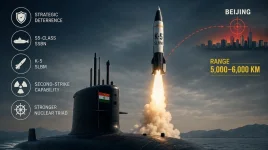
Strategically, the K-5 serves as the underwater counterpart to the land-based Agni-V intercontinental-range ballistic missile.
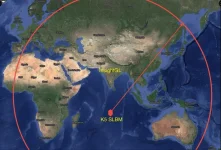
With an estimated operational range of 5,000 to 6,000 kilometres, it brings the ability to strike targets deep inside adversarial territory—such as major industrial or military hubs—while launching from highly secure areas.
Furthermore, the missile will feature Multiple Independently Targetable Re-entry Vehicle (MIRV) technology, enabling a single missile to deploy multiple warheads against distinct targets.
This immense reach allows Indian submarines to conduct deterrence patrols from safely guarded stand-off locations within the Indian Ocean or the Bay of Bengal, far removed from hostile anti-submarine networks.
To accommodate such a formidable weapon, the Indian Navy is developing the next-generation S-5 class of nuclear-powered ballistic missile submarines (SSBNs).
These upcoming vessels will boast a submerged displacement of over 13,500 tons, making them significantly larger than the currently operational Arihant-class fleet, which includes INS Arihant and the recently inducted INS Arighaat.
The massive S-5 submarines are purpose-built to carry heavier, longer-range systems like the K-5, and eventually the planned K-6 variants.
Clearing the complex underwater ejection phase signifies that the most challenging structural and engineering obstacles for the K-5 have been successfully navigated.
Following the validation of the canister and launch dynamics, the defence establishment is expected to commence developmental flight trials from submerged pontoons later this year.
These subsequent tests will rigorously evaluate the missile’s propulsion systems, underwater trajectory sequencing, navigation accuracy, and maximum range capabilities.
Integrating a new strategic asset is a complex endeavour, and defence analysts project that the K-5 will undergo extensive testing over the next few years.
Its final operational induction is planned to coincide with the rollout of the first S-5 class submarine, which is anticipated to join the fleet around 2032.