- Views: 2K
- Replies: 3
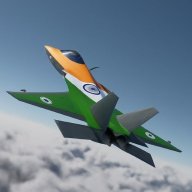
India’s push to secure a fifth-generation stealth fighter to temporarily bridge the gap before its homegrown Advanced Medium Combat Aircraft (AMCA) is ready is facing a unique technical bottleneck.
While top defence officials have floated the idea of buying foreign jets to meet immediate security needs, the formal acquisition has not yet started.
A major sticking point is the strict testing protocols of the Indian Air Force (IAF), which are currently hindered because the two leading candidates—the American F-35 and the Russian Su-57—do not have twin-seater training variants.
The Decade-Long Vulnerability Window
The IAF is dealing with a severe drop in its fighter fleet, with operational squadrons projected to hover around 29 to 31, far below the authorized strength of 42.5. This shortfall is worsening as older Soviet-era jets like the MiG-21 are completely phased out.Meanwhile, the indigenous AMCA is still years away. With prototype rollouts expected around 2027 to 2028, and active service targeted for 2035, India faces a decade-long vulnerability window.
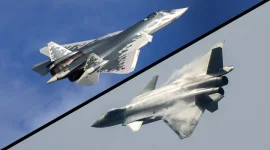
This is especially pressing given China's rapid deployment of hundreds of J-20 stealth fighters and Pakistan’s expected rollout of J-35 jets by 2027.
To counter this, the Ministry of Defence is exploring the purchase of roughly 40 to 60 off-the-shelf stealth fighters.
The Contenders and the Committee
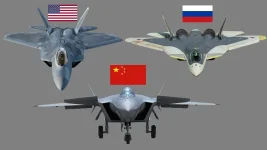
The frontrunners for this interim purchase are Lockheed Martin’s F-35 Lightning II and an upgraded version of Russia’s Sukhoi Su-57 (reportedly the Su-57M1E).However, senior officials note that talks are strictly informal right now, with no official briefings from Washington or Moscow.
A specialized committee, led by the Defence Secretary and involving top military and research chiefs, is actively charting a course to fix these capability gaps and is expected to finalize its recommendations soon to shape the acquisition strategy.
India’s Rigorous Testing Tradition
Historically, India does not buy combat aircraft without putting them through punishing physical trials.The IAF’s elite test teams rigorously push foreign jets to their limits in local environments, from the high altitudes of the Himalayas to intense maritime conditions. Aircraft like the French Rafale and Russian Su-30MKI passed these real-world tests flawlessly.
Usually, this process relies heavily on a twin-seater aircraft, where an Indian pilot flies alongside a foreign instructor to safely master complex manoeuvres and systems before operating solo.
The Core Problem: A Missing Seat
This is where the F-35 and Su-57 present a logistical headache. Both are fundamentally single-seat platforms.- The F-35 relies entirely on highly advanced, multimillion-dollar Full Mission Simulators for pilot conversion, lacking any two-seat version entirely.
- The Su-57 programme is similarly single-seat focused, with twin-seat concepts primarily existing only in theory or for future drone-control purposes.
Geopolitics and Security Constraints
Beyond the physical missing seat, international security restrictions complicate matters further.Neither the United States nor Russia is likely to hand over the keys to their most highly classified stealth platforms for solo test flights by foreign pilots without a finalized deal in place.
The F-35 comes with intense export regulations and strict end-user agreements, while the Su-57 features sensitive, newly upgraded engine and radar technologies that Moscow heavily guards.
Weighing the Trade-Offs on Paper
Without actual flight time, India is forced to weigh complex trade-offs purely on paper or manufacturer claims:- The U.S. F-35 offers unmatched, combat-proven sensor fusion and network capabilities but carries a massive price tag and significant compatibility hurdles with India's existing Russian air defence systems, such as the S-400.
- The Russian Su-57 promises easier integration and potential local manufacturing but carries lingering doubts about its ultimate stealth profile and engine reliability—issues that originally caused India to walk away from a joint stealth programme with Russia in 2018.
However, compromising on hands-on evaluation is a tough hurdle for an air force that needs a reliable, battle-ready bridge to keep the skies secure until the AMCA arrives.