India’s aerial defence network is on the verge of a major technological breakthrough.
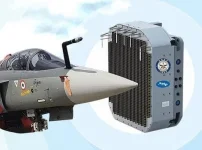
The Indian Air Force’s Airborne Early Warning and Control (AEW&C) aircraft—specifically the existing Netra Mk1A mounted on Embraer platforms and the upcoming Airbus A321-based Netra Mk2—are slated to receive a sophisticated “Gateway” upgrade.
This advancement will enable these aircraft to function as airborne data translators and remote targeting centres for frontline combat jets.
Recent mission suite procurement documents linked to the Netra Mk2 programme from late 2025 and early 2026 highlight the addition of a “Heterogeneous Network Gateway.”
This upgrade represents a critical milestone in India’s ongoing transition toward a fully connected, sensor-to-shooter combat framework.
Fundamentally, this Gateway technology permits the Netra fleet to gather radar and surveillance intelligence from a wide variety of ground and airborne sensors.
Because these sensors often use distinct communication rules, the Gateway processes and merges the mixed data internally. It then broadcasts precise, targeting-grade coordinates to fighter aircraft through India’s advanced SDL-II tactical data link.
Through this integration, the Netra platforms will evolve from standard airborne surveillance planes into dynamic battle-coordination hubs that actively relay combat data.
This development is highly advantageous for an air force that operates a diverse fleet.
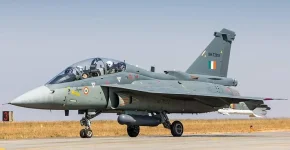
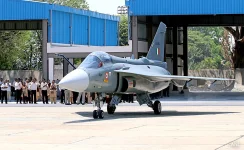
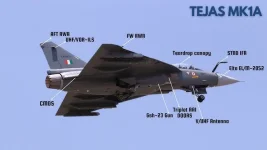
Integrating aircraft like the indigenous Tejas Mk1A, the Russian-origin Su-30MKI, the French Rafale, and the upcoming Advanced Medium Combat Aircraft (AMCA) has historically been difficult due to their different electronic systems, radars, and data link standards.
The Gateway is specifically designed to eliminate these communication barriers.
Going forward, the Netra systems will capture information from powerful S-band airborne radars, ground control stations, and electronic intelligence tools.
The Gateway will instantly translate this intelligence and beam it out over the SDL-II network in a format that any connected frontline fighter can understand.
This creates a shared, comprehensive view of the battlefield, meaning that fighter pilots will no longer have to rely exclusively on their own aircraft's sensors to locate and track hostile targets.
The most revolutionary operational benefit of this system is the Netra’s ability to act as a “Remote Sensor” during Beyond Visual Range (BVR) combat.
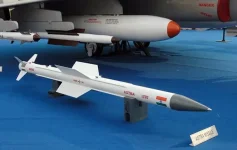
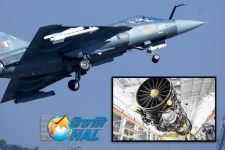
In a real-world scenario, a Tejas Mk1A could receive pinpoint target coordinates from the Netra AWACS via the SDL-II link and launch a long-range weapon—such as the indigenous Astra Mk2 BVR missile, which boasts a dual-pulse motor and a range exceeding 160 kilometres—without ever turning on its own radar system.
This tactic provides tremendous combat advantages.
Primarily, it drastically reduces the fighter jet's electromagnetic footprint. When a fighter uses its radar, it emits strong signals that enemy radar warning receivers can instantly detect, giving away the jet's position.
By remaining radar-silent, the Indian fighter stays hidden from enemy electronic sensors during the most critical phases of an attack.
Additionally, the fighter pilot benefits from the superior vision of the AWACS. Because the Netra Mk2’s powerful radars operate at high altitudes, they can see much further over the horizon than the smaller radars fitted to fighter jets.
This grants pilots exceptional situational awareness and the ability to track threats from safely out of the enemy's reach.
In combat, this stealthy approach means that an adversary might not realise an Indian fighter is in the area until an Astra Mk2 missile is already closing in on them.
This networked architecture also paves the way for cooperative engagement.
A group of mixed-fleet fighters could receive the same target information from a Netra platform simultaneously, allowing them to coordinate their flight paths and missile launches perfectly over the secure SDL-II network.
To manage this immense flow of data, the mission computers and network systems aboard the Netra Mk2 are being heavily upgraded to ensure multi-aircraft coordination happens without lag.
Developing this Gateway capability is essential for the future of aerial combat, which will undoubtedly feature intense electronic warfare and signal jamming. In such environments, aircraft must minimise their radar emissions to survive while remaining lethal.
With regional neighbours deploying stealth fighters, long-range air-to-air missiles, and advanced electronic warfare tools, the Indian Air Force is rapidly moving away from relying on individual aircraft capabilities.
Instead, the focus is firmly on network-enabled defence strategies, ensuring that every asset in the sky operates as part of a unified, highly lethal whole.