As India continues to fortify its multi-layered air defence network with the Russian-made S-400 Triumf and the indigenous Project Kusha (Extended Range Air Defence System), a unique tactical question frequently arises: could these surface-to-air systems be modified to strike ground targets during an emergency?
While the short answer is technically yes, the reality is much more complex. Exploring this possibility reveals the intricate mechanics of modern air defence systems and highlights why the Indian military strictly separates its ground-strike capabilities from its anti-aircraft operations.
The S-400’s Unconventional Role in Ground Strikes
Originally engineered as an advanced shield to eliminate enemy aircraft, cruise missiles, and ballistic threats at long distances, the S-400 has recently taken on an unexpected role.During the ongoing conflict in Ukraine, Russian forces have adapted S-400 batteries to launch surface-to-air interceptors—specifically derived from the 48N6 missile family, such as the repurposed RM-48U variant—at terrestrial targets.
Recent intelligence indicates that Russia has even deployed specialized missile groups in regions like Bryansk and Rostov for this exact purpose. While this falls entirely outside the system’s primary design, the guidance technology of the missile makes such strikes technically possible.
In its standard anti-aircraft mode, a 48N6 interceptor relies on inertial navigation and mid-course radio updates, eventually switching to radar homing to track moving airborne targets.
However, when instructed to hit a stationary ground coordinate, the missile simply follows a high-speed ballistic trajectory until it reaches the destination and detonates.
The critical difference lies in the payload. The S-400’s warhead is designed to spray fragmentation to destroy aircraft mid-flight, meaning it lacks the penetrating power required to demolish hardened ground structures.
Consequently, it functions more like a massive, highly expensive unguided rocket rather than a precision strike weapon.
Driven by Munition Shortages, Not Military Strategy
Russia's decision to launch S-400 interceptors at ground targets is widely seen by defence analysts as a symptom of depleting stockpiles of dedicated surface-to-surface ballistic missiles, such as the Iskander, rather than a planned tactical shift.Using an expensive anti-aircraft missile against a building is highly inefficient. It ties up a valuable air defence battery, consumes interceptors meant to protect the skies, and delivers a much smaller explosive impact than purpose-built ground-attack missiles.
Every interceptor wasted on a terrestrial target leaves the battery with one less weapon to counter actual aerial threats.
Project Kusha: Dedicated Exclusively to Air Defence
Meanwhile, India’s Defence Research and Development Organisation (DRDO) is advancing Project Kusha to serve a strategic role similar to the S-400.Designed with three distinct interceptor variants (M1, M2, and M3) capable of hitting targets at approximate ranges of 150 km, 250 km, and 350 to 400 km, the system is strictly intended to neutralize fighter jets, drones, and incoming missiles.
Official disclosures regarding Project Kusha consistently describe it as an air defence shield, with absolutely no mention of a secondary land-attack capability.
From a technical standpoint, however, a missile's intended purpose and its physical capabilities can differ.
Project Kusha’s interceptors utilize advanced Gallium Nitride (GaN) Active Electronically Scanned Array (AESA) seekers and inertial navigation with mid-course updates.
Because this guidance architecture fundamentally calculates trajectories and timing, it could theoretically be redirected to a fixed point on the earth.
If the fire-control software were modified, the missile could theoretically fly a ballistic path toward the ground. It is the software and warhead design—not the physical airframe—that dictates the missile's role.
The Warhead Limitation Remains the Same
When comparing the S-400 and Project Kusha, the most significant obstacle to ground-attack conversion becomes clear: the warhead.Both systems rely on blast-fragmentation technology engineered to shred fragile aircraft components in the sky.
Neither the Russian system nor the upcoming Indian interceptors were built with ground-penetrating warheads or terrain-targeting software.
Russia's improvised use of the S-400 in Ukraine merely proves that the guidance software can be manipulated, not that the system is a genuinely effective dual-purpose weapon.
India’s Robust Surface-to-Surface Arsenal
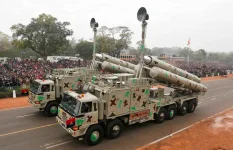
For India, the idea of repurposing Project Kusha for land attacks is unnecessary because the armed forces already possess a highly capable, rapidly growing arsenal of surface-to-surface missiles.Weapons like the BrahMos, Pralay, Shaurya, and Nirbhay were specifically designed from the beginning to execute precision ground strikes.
These missiles feature specialized warheads, advanced terrain-matching guidance packages, and optimized flight paths that a modified air defence interceptor simply cannot replicate.
Maintaining a strict separation between air defence and land-attack missions is sound military strategy.
The primary value of an S-400 or Project Kusha battery is its ability to secure the airspace continuously. Diverting these scarce, high-tech interceptors for inefficient ground strikes would severely weaken India's defensive shield.
Ultimately, neither system is a true land-attack weapon; Russia's use of the S-400 in this manner is a wartime compromise, while India's approach reflects a deliberate, well-resourced doctrine that keeps the skies protected and ground targets firmly in the crosshairs of dedicated strike missiles.