- Views: 2K
- Replies: 2
A fierce industrial contest is brewing between state-run Mazagon Dock Shipbuilders Limited (MDL) and private engineering giant Larsen & Toubro (L&T) over the Indian Navy's highly anticipated Project-76.
Both shipbuilding heavyweights are aggressively advancing their own indigenous submarine designs to secure the landmark contract.
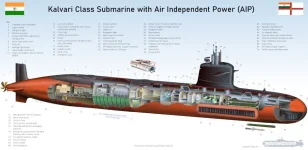
According to industry insiders, MDL is channelling its expertise into a new 3,000-tonne conventional submarine blueprint. This concept leans heavily on the technological foundation of the Kalvari-class fleet, which was initially based on the French Scorpene design.
Set to become India’s premier fully homegrown conventional attack submarine initiative, Project-76 marks a decisive shift away from legacy import-reliant ventures like the Shishumar, Kalvari, and upcoming P-75I projects.
Open-source data suggests the Navy envisions a fleet of up to 12 of these next-generation vessels to replace its ageing platforms, targeting an ambitious 70% to 80% domestic hardware content.
Moving past foreign blueprints, this new generation of submarines will be tailored specifically for the Indian Navy's future combat needs.
The focus is on extended underwater endurance powered by scaled-up Defence Research and Development Organisation (DRDO) Air Independent Propulsion (AIP) systems and lithium-ion batteries, alongside advanced stealth features, vertical launch systems for land-attack cruise missiles, and entirely domestic combat suites.
To fast-track development, the Navy is reportedly evaluating existing private-sector research, specifically L&T’s SOV-400 program.
Originally drafted as a compact 400-500 tonne vessel for special forces operations, the SOV-400’s modular framework—which has already received European engineering validation—is being scaled up.
This strategy allows L&T to pitch a robust 2,500 to 3,000-tonne frontline warship without the delays of starting a design entirely from scratch. By adopting a pre-studied modular architecture, naval planners hope to mitigate developmental risks and speed up the Project-76 timeline.
While MDL holds the crown for conventional submarine manufacturing in India, L&T brings formidable credentials from the strategic sector.
Over the last twenty years, the private firm has mastered complex pressure hull fabrication and nuclear submarine construction through its extensive contributions to the Arihant-class ballistic missile submarine program.
L&T has consistently pushed to break into the conventional submarine space, most notably by pitching the Spanish S-80 design alongside Navantia during the recent P-75I bidding process.
Ultimately, the Navy favoured MDL's joint venture with Germany's TKMS, which proposed a variant of the U-212CD for the P-75I requirement.
Undeterred by the P-75I outcome, L&T views Project-76 as its prime avenue to disrupt MDL's monopoly in the conventional sector. In response, MDL has accelerated its own research, informally dubbing its next-generation proposal the "Super Kalvari."
This upgraded model will maintain the proven operational reliability of the current fleet while introducing a larger hull, superior acoustic dampening, and next-generation domestic weaponry.
MDL's deep-rooted familiarity with Scorpene production lines, combat system integration, and lifecycle maintenance gives it a formidable edge.
Both competitors are striving to finalize and submit their conceptual designs to the Navy by 2028, effectively matching the projected timeline for the Navy's own indigenous design maturation.
Ultimately, this head-to-head rivalry promises massive strategic dividends for the nation's defence sector.
By pushing both public and private shipyards to innovate, the Indian Navy stands to gain a technologically superior fleet, slash its reliance on foreign defence contractors, and build a resilient, self-sufficient underwater warfare industry.