A recent collaboration between European aerospace giant Airbus and Japan's Kawasaki Heavy Industries to develop an anti-submarine warfare (ASW) variant of the U950 Eurodrone is drawing immense strategic interest.
Capable of flying for up to 40 hours and carrying heavy payloads like sonobuoys and torpedoes, this unmanned aerial vehicle offers a revolutionary approach to securing India’s maritime borders.
By deploying such technology, the Indian Navy could drastically enhance its surveillance blanket over the critical waters of the Arabian Sea and the Bay of Bengal, marking a crucial transition toward using autonomous drones for complex, high-stakes maritime missions.
At present, India’s naval watchfulness is largely anchored by a fleet of 12 Boeing P-8I Poseidon patrol aircraft, which will soon be bolstered by six additional units under a recently cleared $3 billion deal.
Furthermore, the military is awaiting the delivery of 15 MQ-9B Sea Guardian drones following a landmark $3.5 billion agreement signed with the United States in late 2024.
Integrating a platform like the Eurodrone would introduce the tactical advantage of manned-unmanned teaming (MUM-T).
Under this concept, the drones would independently scout vast stretches of the ocean to pinpoint enemy activity, allowing highly sophisticated—and expensive—manned aircraft to focus solely on neutralising confirmed targets.
This strategy effectively multiplies the Navy's operational reach across both coastlines without the need for a massive expansion in crewed aircraft.
The urgency for these advanced ASW capabilities is highlighted by a rapidly escalating regional threat environment.
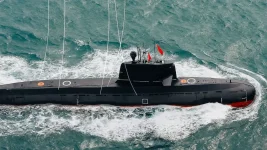
In June 2026, Pakistan took delivery of the PNS Hangor, the first of eight Chinese-designed submarines equipped with Air Independent Propulsion (AIP) technology, allowing them to remain submerged and hidden for extended periods.
When combined with China's formidable fleet of approximately 60 submarines, the Indian Ocean is becoming increasingly congested and contested.
The painful historical memory of the 1971 war, during which the Indian frigate INS Khukri was sunk by a Pakistani submarine, serves as a stark reminder of the devastating potential of undersea warfare.
Employing persistent, long-range drones would strip away the stealth advantages of adversary vessels by extending India's detection perimeters and enabling early threat preemption.
Looking ahead, the potential adoption of a maritime Eurodrone variant promises to transform India's undersea domain awareness, serving as a powerful deterrent against covert incursions in the Indian Ocean Region.
On the flip side, any hesitation or bureaucratic delay in adopting next-generation uncrewed surveillance could create dangerous vulnerabilities, precisely when regional rivals are rapidly modernising their subsurface fleets.
Ultimately, the evolving naval landscape makes it abundantly clear that continuous, autonomous drone operations will form the very backbone of India's maritime defence strategy for decades to come.