- Views: 5K
- Replies: 26
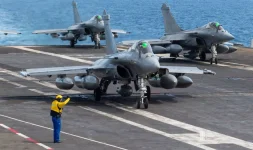
The Dassault Rafale has solidified its position as the premier choice for the Indian Air Force’s (IAF) pressing requirement for 114 multi-role fighter aircraft (MRFA).
This preference is largely driven by the fleet’s exceptional serviceability rate, which consistently hovers around 90 per cent.
This figure not only exceeds the IAF's internal benchmarks but also outperforms virtually every other frontline fighter in operation today, including the fifth-generation American F-35.
Availability as the Ultimate Combat Metric
For Indian defence planners, the availability of an aircraft is as vital as its speed or weapon payload.In a scenario involving a two-front threat, the true measure of air power is not the total number of aircraft on paper, but the number of jets that can be launched immediately for combat.
In this regard, the Rafale has proven to be the most reliable asset in the IAF’s inventory.
While most modern fighter fleets globally struggle to maintain serviceability rates between 60 and 75 per cent due to complex logistical needs and fragile avionics, the Rafale has normalised a 90 per cent readiness rate.
This reliability ensures that for every 10 Rafales in a squadron, nine are ready to fight at any given moment—a force multiplier that effectively increases the fleet's operational size.
Engineering for Rapid Turnaround
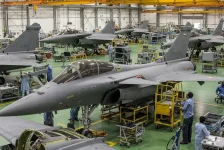
The secret to this high availability lies in the Rafale’s "maintainability-first" design philosophy.The aircraft utilises a modular architecture featuring Line-Replaceable Units (LRUs). These allow ground crews to quickly swap out faulty avionics or mission systems right on the flight line, avoiding the need for lengthy hangar repairs.
Furthermore, the maintenance ecosystem is supported by advanced predictive health monitoring. This system analyses data from the aircraft’s components to forecast potential failures before they occur, drastically reducing unscheduled downtime.
Unlike the American F-35, which relies on the complex and often troubled Autonomic Logistics Information System (ALIS), the Rafale’s support system has proven to be robust and easier to manage in Indian operational conditions.
The F-35 Contrast
The comparison with the Lockheed Martin F-35 is particularly revealing for defence analysts. While the F-35 offers unmatched stealth and sensor fusion, it remains plagued by maintenance bottlenecks.Recent data indicates that the F-35 fleet often operates with mission-capable rates in the 50 to 60 per cent range, hampered by shortages of spare parts and software stability issues.
For the IAF, which requires a workhorse capable of sustaining high-tempo surge operations from high-altitude bases in Ladakh to the maritime theatre in the Indian Ocean, the Rafale’s proven maturity offers a distinct advantage over the developmental teething troubles still affecting the F-35 program.
Strategic Autonomy and Future Procurement
The Rafale’s case for the 114-jet MRFA tender is further strengthened by India’s developing indigenous support structure.With Dassault Aviation establishing a Maintenance, Repair, and Overhaul (MRO) facility in Hyderabad and committed to a significant "Make in India" component—potentially up to 80 per cent for new orders—the supply chain for spares is becoming increasingly localised.
Reports also suggest that a potential government-to-government deal for additional Rafales could include upgrades to the F4 standard and the eventual incorporation of the futuristic F5 variant.
This would ensure that the IAF not only maintains high availability today but also stays technologically relevant for decades to come.
Beyond mere availability, the Rafale continues to deliver as a true "omni-role" platform. It can execute air superiority, deep precision strikes with SCALP missiles, and nuclear deterrence missions without needing to be reconfigured.
This versatility, combined with rock-solid reliability, makes it the pragmatic frontrunner to form the backbone of India’s future air combat capability.