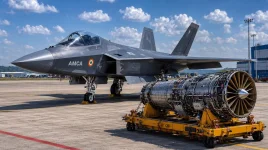
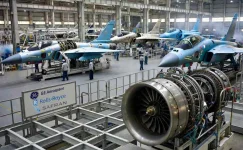
Amid the growing race to co-develop the engine for India’s Advanced Medium Combat Aircraft (AMCA) programme, Rolls-Royce is highlighting its deep background in top-tier fighter propulsion.
Sashi Mukundan, the Executive Vice President for Transformation at Rolls-Royce India, recently drew attention to the firm’s credentials in fifth-generation technologies.
He asserted that the company’s distinct technical know-how is exactly what India needs to achieve its long-term aerospace goals.
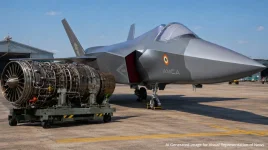
To prove its capabilities, Rolls-Royce points to its crucial contribution to the Lockheed Martin F-35B Lightning II.
This aircraft stands as the world’s only active stealth fighter capable of short take-offs and vertical landings (STOVL).
Although Pratt & Whitney provides the primary F135 engine, Rolls-Royce is the creator and manufacturer of the vital LiftSystem—the unique technology that allows the fighter to hover in mid-air and touch down vertically.
Mukundan's remarks intentionally showcase the British company's work on one of the most complex combat propulsion systems ever built.
Creating engines for fifth-generation stealth jets demands skills far beyond building standard commercial or military jet engines.
It requires mastery over advanced heat management, high-performance materials, complex power transfer mechanisms, modern digital controls, and seamless blending with the aircraft's internal flight systems.
The engineering behind the F-35B is widely celebrated as a modern aerospace marvel.
At the heart of the aircraft is a powerful afterburning turbofan engine, which produces massive forward thrust for regular flight as well as the tremendous mechanical power needed for vertical operations.
However, true hovering is only possible because of the Rolls-Royce LiftSystem.
During vertical manoeuvres, the main engine sends about 29,000 shaft horsepower through a drive shaft to a special counter-rotating fan located right behind the pilot.
This fan forces a strong column of cool air downward to keep the front of the jet balanced.
Furthermore, Rolls-Royce designed stabilising "roll posts" under the wings to provide side-to-side control while hovering.
At the rear, a complex swivel nozzle redirects the hot exhaust downward, completing the delicate balance of forces needed to keep the jet suspended in the air.
The successful blending of these systems turned the F-35B into a historic achievement: the first operational supersonic stealth jet that can take off from short runways and land vertically.
Aviation experts frequently cite this LiftSystem as one of the most complicated pieces of machinery ever put into a combat plane.
By showcasing this intricate work, Rolls-Royce is framing itself as an expert in integrated power systems, not just a traditional engine builder. The company wants to prove it has the advanced technologies and design skills needed to support not only the AMCA but other future Indian aerospace projects as well.
The timing of this pitch is crucial. The Indian Ministry of Defence is currently reviewing proposals for a new 110-130 kN class engine to power the upcoming AMCA Mk2.
According to recent 2026 industry updates, Rolls-Royce is offering a "clean-sheet" engine design specifically tailored for India, complete with 100 percent transfer of technology.
The pitch includes full intellectual property (IP) rights for India, meaning the nation could freely upgrade or modify the engine in the future.
The company is aiming for ground trials by 2032 and a first flight by 2034, with the potential to adapt the core design for future naval and civil aviation needs.
Rolls-Royce faces fierce competition from France’s Safran, which is also aggressively pitching a co-development deal based on its experience with the Rafale's M88 engine.
Both aerospace giants are trying to convince New Delhi that they hold the key to providing a high-performance engine while simultaneously laying the groundwork for a robust, domestic propulsion industry.
For India, developing an advanced fighter engine domestically remains one of the final hurdles in achieving complete defence independence.
The partner ultimately chosen for the AMCA project will dictate how quickly India can close this technological gap and finally design, build, and upgrade military jet engines entirely on its own.
While the F-35B’s hovering system is entirely different from a standard fighter engine, Rolls-Royce is using this success to prove its active role in the world's most advanced fifth-generation aviation ecosystem.
Combined with an unprecedented offer of full IP rights and domestic manufacturing, Rolls-Royce hopes this proven expertise will help it secure one of the most vital defence partnerships in India’s history.