Russia has presented India with a major new aerospace proposal aimed at reviving the stalled Fifth Generation Fighter Aircraft (FGFA) partnership, from which New Delhi withdrew in 2018.
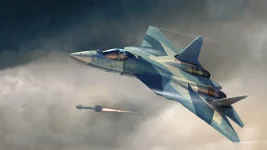
Moscow is now offering a highly modified, twin-seat version of its Su-57 stealth fighter, specifically built for Manned-Unmanned Teaming (MUM-T).
Rather than a standard stealth jet, Russian officials describe this aircraft as a vital stepping stone between current fifth-generation fighters and future sixth-generation warfare technologies.
Defence analysts suggest this is being pitched as an interim solution to maintain the Indian Air Force's regional superiority before the indigenous Advanced Medium Combat Aircraft (AMCA) enters production in the mid-2030s.
While Western nations typically rely on artificial intelligence to help a single pilot handle both flight and drone operations—such as in the F-35—Russia is focusing on a human-led design.
The proposed twin-seat Su-57 features a dedicated rear cockpit for a Weapon Systems Officer (WSO). This officer serves as a tactical mission commander, actively directing unmanned drones in real time.
By dividing the workload, the pilot in the front seat can concentrate purely on flying and air-to-air combat. Meanwhile, the rear commander manages complex drone coordination, analyses sensor data, and assigns specific targets for strikes, surveillance, or electronic warfare.
To handle these demanding tasks, the rear cockpit will feature large panoramic multi-function displays designed specifically for network-centric combat. This digital workspace allows the mission commander to seamlessly track and control multiple drones at once.
By combining information gathered from the drones, the aircraft's own sensors, and other allied forces on the battlefield, the system provides a unified and clear tactical picture.
This integrated interface is meant to greatly speed up decision-making and improve targeting accuracy in high-stress combat situations.
A major part of Russia's pitch involves teaming the Su-57 with the S-70 Okhotnik-B stealth drone.
Open-source data shows the S-70 is a massive, 20-ton unmanned combat aerial vehicle with a 6,000-kilometre range and a payload capacity of nearly 3 tons in its internal bays.
According to Russian sources, a single twin-seat Su-57 could coordinate a swarm of four to eight of these heavy drones.
The drones would be sent forward into dangerous, heavily guarded enemy airspace to launch attacks, destroy enemy air defences, or act as decoys.
At the same time, the manned Su-57 remains safely behind, acting as a secure airborne command centre.
To appeal to New Delhi's strict focus on self-reliance, Russia is offering deep integration of Indian technologies into this new ecosystem.
During recent discussions, which gained traction around the Wings India 2026 exhibition, Moscow proposed an open-architecture system.
This means Indian-made drones, sensors, and weapons—such as the BrahMos and Astra missiles—could be easily linked to the Su-57's command network.
This approach allows India to incorporate foreign stealth technology while still advancing its own domestic defence capabilities.
Addressing past complaints over work-sharing that led India to leave the original FGFA programme, this new offer guarantees a complete transfer of technology and full local manufacturing rights.
This promises significant industrial growth and sovereignty for Indian defence companies.
Furthermore, Russian officials have indicated that this twin-seat project is already well underway.
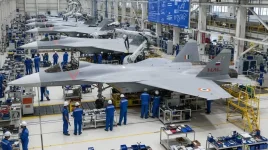
The main fuselage of the first twin-seat prototype is reportedly currently being assembled at the Komsomolsk-on-Amur Aircraft Plant (KnAAZ) in Russia, proving the design has advanced from the drawing board to physical hardware.
The new fighter is slated to use advanced AL-51F1 (also known as Izdeliye 30) engines.
Open-source specifications suggest these modern powerplants produce roughly 108 kN of dry thrust, giving the aircraft true "supercruise" capability—the ability to fly at sustained supersonic speeds of up to Mach 1.5 without using fuel-heavy afterburners.
The twin-seat model will also carry more internal fuel than the single-seat variant, extending its overall operational range.
Despite having a larger, two-person cockpit, the aircraft is expected to maintain its stealth profile through the use of internal weapons bays and specialized radar-absorbing materials applied to the redesigned canopy.