- Views: 4K
- Replies: 22
Moscow’s latest proposal to share technology and locally produce the Su-57 fifth-generation stealth fighter in India is motivated by wider strategic goals, rather than just fulfilling the requirements of the Indian Air Force (IAF).
Following Russian President Vladimir Putin's public offer for joint development during the St. Petersburg Economic Forum in June 2026, it is clear that Russia aims to replicate the highly successful Su-30MKI partnership.
By leveraging India's expanding defence industrial base, Moscow hopes to reinforce the Su-57 programme, secure its global supply chains, and manufacture aircraft for both its own military and international buyers.
The current Russian proposition seeks to deeply embed Indian enterprises within the global manufacturing network of the Su-57.
Instead of merely setting up a licensed assembly line meant solely for Indian airspace, Moscow envisions Indian defence firms acting as permanent suppliers of crucial components and subsystems.
These Indian-made parts would theoretically be integrated into fighter jets built for the Russian Aerospace Forces, as well as for future foreign clients.
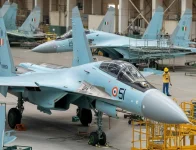
This blueprint heavily mirrors the historic Su-30MKI project, which empowered India to build a robust aerospace manufacturing foundation through state-owned Hindustan Aeronautics Limited (HAL) alongside numerous local vendors.
However, this new initiative is even more ambitious. By having Indian companies manufacture parts for Russia’s domestic fleet, Moscow aims to resolve the ongoing supply chain bottlenecks that have hampered the broader rollout of the Su-57 programme.
Despite Russia’s grand vision, the Indian Air Force’s immediate needs contrast sharply with Moscow’s objectives.
Current assessments suggest that the IAF is looking to procure a maximum of two to three squadrons of the Su-57—equating to around 36 to 54 fighter jets.
Furthermore, the IAF strongly prefers a direct, off-the-shelf purchase to quickly bridge the gap in its combat fleet capabilities. Such a small order volume would make the massive financial investment required to set up a dedicated domestic production line economically unviable.
To counter this, Russian negotiators are urging New Delhi to commit to the local manufacturing of approximately 100 Su-57 aircraft.
Committing to a larger order would generate the economies of scale necessary to make a joint production facility financially practical.
Such a large-scale project would also give Indian manufacturers the opportunity to gain advanced technical expertise and secure their position as vital, long-term partners in the aircraft's global supply network.
Observers note that Russia views India's active participation as a vital lifeline to inject fresh momentum and financial backing into the Su-57 project, which has struggled to reach mass production.
Although the stealth fighter—known by its NATO reporting name "Felon"—is technically operational within the Russian military and has seen limited combat deployment, the number of active jets remains much lower than originally projected.
By expanding production into India, Russia hopes to reduce manufacturing costs, ensure a steady flow of spare parts, and make the aircraft more appealing to other international buyers.
Ultimately, bringing Indian defence companies into the Su-57 supply chain would grant Russia a secure, diversified industrial base to meet its own military needs and execute export contracts.
For India, however, the choice is highly complex. New Delhi must carefully weigh the undeniable benefits of advanced technology transfer against its urgent operational needs and its deep commitment to self-reliance.
This is especially true given India's massive ongoing investments in its own fifth-generation fighter, the Advanced Medium Combat Aircraft (AMCA), which recently moved into the prototype manufacturing phase with Indian private sector giants.
Procuring the Su-57 could act as a stopgap measure, but India will need to ensure it does not derail its homegrown aerospace ambitions.