India’s indigenous missile capabilities are set for a major expansion as the Aeronautical Development Establishment (ADE) prepares to begin carriage trials for the air-launched version of the Long-Range Land Attack Cruise Missile (LR-LACM).
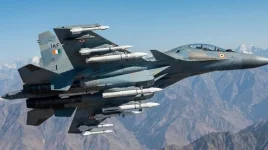
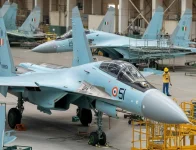
Following the successful validation of ground and sea-based variants, the Indian Air Force’s (IAF) Su-30MKI fighter jet has been selected as the primary platform for these upcoming tests throughout 2026.
Technical Integration and Design
Engineers have adopted a highly efficient integration strategy by utilizing the existing underwing pylon originally designed for the BrahMos-A supersonic missile.This approach allows the LR-LACM to be mounted on the Su-30MKI with minimal structural changes to the aircraft, significantly shortening the development timeline.
Unlike the land and naval versions, the air-launched variant does not require a solid rocket booster for takeoff. Instead, it leverages the aircraft’s forward momentum—typically released at speeds around Mach 0.6—to initiate flight.
To support high-altitude launches, the missile features a specialized air intake and reinforced aerodynamic surfaces designed to withstand the turbulent conditions of external carriage on a supersonic fighter.
Performance and Strategic Reach
The LR-LACM is a subsonic cruise missile capable of striking targets at distances of approximately 1,000 km.It is powered by the indigenous Manik small turbofan engine, a critical component in India’s drive for self-reliance in defence technology. Key features of the missile include:
- Terrain Hugging: The ability to fly at very low altitudes to evade enemy radar.
- Precision Guidance: Uses GPS/NavIC and an advanced radio frequency (RF) seeker for terminal accuracy.
- Stealthy Profile: Its subsonic speed and low-altitude flight path make it difficult for modern air defence systems to intercept.
Expanding the Fleet’s Lethality
While the initial trials are focused on the heavy-duty Su-30MKI, the weight reduction achieved by removing the launch booster makes the missile a candidate for smaller platforms.Future plans include integrating the LR-LACM with the Tejas Mk1A, the upcoming Tejas Mk2, and potentially the Rafale fleet. This would grant India’s light combat aircraft a "standoff" capability, allowing them to strike deep into enemy territory from safe distances.
Project Timeline
The current phase of "captive carriage" trials will focus on validating the structural integrity and aerodynamic flow of the missile while attached to the jet.If these tests remain on schedule, separation trials—where the missile is dropped to test its release safety—and full-scale flight tests are expected to take place by 2027.
This project represents a natural evolution of the earlier Nirbhay and ITCM (Indigenous Technology Cruise Missile) programs, consolidating years of research into a reliable, long-range strike weapon for all three branches of the Indian Armed Forces.