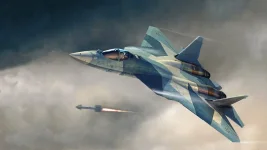
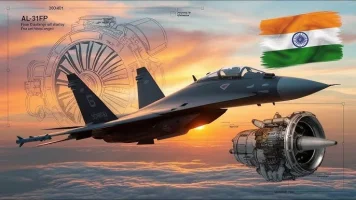
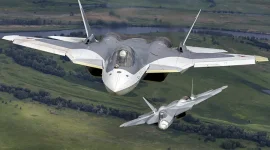
Russian officials have recently briefed the Indian Air Force (IAF) and the Ministry of Defence (MoD) regarding the development timeline of the Su-57 stealth fighter's next-generation powerplant.
According to the briefing, the advanced AL-51F-1 engine—widely known as "Product 30" and linked to recent "Product 177" testing—will require another five to seven years before it achieves full-scale operational readiness.
Designed as the definitive second-stage engine for the fifth-generation aircraft, this powerplant is currently undergoing rigorous flight trials.
Once complete, it promises to dramatically boost the jet's capabilities by offering superior supercruise ability, enhanced thrust-to-weight ratios, lower fuel consumption, and reduced lifecycle maintenance costs compared to the interim AL-41F1 engines currently in use.
While ongoing test flights have yielded highly positive results and met critical performance benchmarks, Russian developers acknowledge that extensive validation and certification processes are still necessary before mass production.
However, Moscow has offered a crucial guarantee to Indian defence planners: the new AL-51F-1 engines are engineered as a direct replacement.
Representatives from Rostec and the United Aircraft Corporation (UAC) assured that these advanced engines can be installed into the current Su-57 airframes without the need for expensive or complex structural modifications.
This seamless upgrade pathway holds immense strategic value for India. If the IAF chooses to procure the Su-57, it will not have to wait years for the final engine to be certified.
Instead, India could induct the fighters now with their existing, readily available engines and smoothly transition to the advanced AL-51F-1 later as part of a routine modernisation programme.
For Russia, this plug-and-play capability serves as a powerful incentive for both domestic and international buyers, ensuring that operators can deploy the fighter immediately while securing future technological leaps without overhauling their fleets.
This engine assurance arrives at a critical juncture in India-Russia defence relations.
Recent reports indicate that Russian President Vladimir Putin has renewed an offer for the joint production of the Su-57 with India, promising full technology transfer without restrictions.
Furthermore, Russian aerospace engineers have reportedly begun testing a twin-seat variant of the Su-57, a configuration historically favoured by the IAF for complex strike, drone-coordination, and electronic warfare missions.
With the indigenous Advanced Medium Combat Aircraft (AMCA) unlikely to enter service before 2035, and regional neighbours actively pursuing fifth-generation fleets, the ability to procure the Su-57 today and easily upgrade its engines tomorrow offers a highly practical interim solution to bridge India's airpower gap.
Ultimately, the future AL-51F-1 engine remains the key to unlocking the true fifth-generation potential of the Su-57.
Russian authorities maintain that the highly anticipated powerplant will reliably extend the fighter's operational range and overall combat effectiveness.
By ensuring that current airframes are fully compatible with tomorrow's technology, Russia aims to present the Su-57 as a future-proof asset tailored to meet the evolving needs of the Indian Air Force.