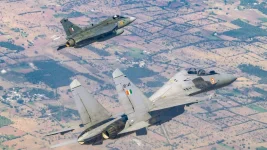
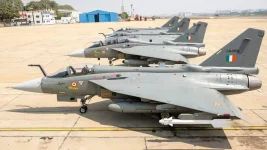
The Indian Air Force (IAF) is on the verge of a major capability upgrade as Hindustan Aeronautics Limited (HAL) readies the first batch of Tejas Mk1A fighter jets for induction.
Following recent breakthroughs in the supply of critical GE F404-IN20 engines, the IAF plans to deploy these advanced indigenous fighters directly to forward bases, bringing a sharp tactical edge against regional adversaries.
Engine Supplies Stabilise and Production Accelerates
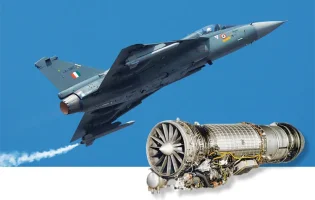
Initial delays in the Mk1A programme were largely tied to the disrupted supply of GE F404-IN20 engines from the United States.However, that bottleneck is now easing. In August 2026, GE Aerospace shipped three additional engines to HAL, bringing the total number received to ten.
HAL expects to secure 22 engines by December 2026, allowing production lines to finally accelerate and meet IAF deadlines.
The IAF has a massive requirement for the jet. Following a Rs 48,000 crore contract signed in 2021 for 83 aircraft, a subsequent clearance for 97 additional units brings the total planned fleet to 180 Mk1A fighters.
With an estimated unit cost of around Rs 600 crore, the Mach 1.8 capable aircraft represents the cornerstone of India’s push for self-reliance in aerospace manufacturing.
Strategic Deployment at the Frontier
To maximise operational impact, the first Tejas Mk1A squadrons will be stationed at forward locations in Rajasthan, prominently the Nal Air Base in Bikaner.Positioned just kilometres from the international border, this strategic deployment drastically cuts down reaction times.
In the event of an airspace breach, the fighters can scramble and intercept threats almost instantly, fortifying India's western air defence grid.
Winning the Stealth Battle: Tejas Mk1A vs J-10C
A defining feature of the Tejas Mk1A is its exceptionally low Radar Cross-Section (RCS).Built extensively with composite materials, coated in radar-absorbent paint, and designed with Y-shaped air intakes to shield the spinning engine blades, the jet is inherently difficult for enemy radar systems to spot.
Defence assessments suggest the Mk1A’s frontal RCS is roughly 60% lower than that of the Chengdu J-10C, a Chinese-built fighter currently being inducted by the Pakistan Air Force (PAF).
While the J-10C incorporates its own radar-reduction features, its physically larger airframe yields a higher radar signature—frequently estimated by aviation analysts to sit between 0.5 and 1.5 square metres.
Because the Tejas is harder to detect, it secures a vital "track first, shoot first" advantage over heavier, more visible opponents.
Astra Mk1 and Uttam AESA: A Lethal Combination
The Mk1A’s stealth is paired with cutting-edge electronics and weaponry.The aircraft is equipped with advanced electronic warfare suites and powerful sensors, eventually transitioning to the indigenous Uttam Active Electronically Scanned Array (AESA) radar to detect targets from vast distances.
In Beyond Visual Range (BVR) combat, the Indian jet relies on the locally produced Astra Mk1 active radar-guided missile.
Recent enhancements by the DRDO have expanded the Astra Mk1's effective head-on strike range to approximately 160 kilometres.
This provides a distinct reach advantage over the PAF J-10C fleet, which utilises the PL-15E export missile, a weapon generally capped at a range of around 145 kilometres.
Due to the Mk1A’s smaller radar profile and the extended reach of the Astra missile, an IAF pilot can lock onto an adversary, launch a strike, and safely break away before the enemy's systems can even register the danger.
A Capable Deterrent
Pakistan acquired the J-10C specifically to counter the IAF's modernising fleet.However, the Tejas Mk1A counters with a completely different design philosophy: a lightweight, highly agile, multirole fighter engineered to slip through radar nets.
Operating alongside heavy-weight fighters like the Rafale and Su-30MKI, the Tejas Mk1A will form a lethal layer of India's combat aviation, ensuring the IAF maintains dominance in contested skies.