- Views: 2K
- Replies: 5
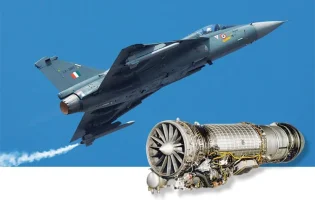
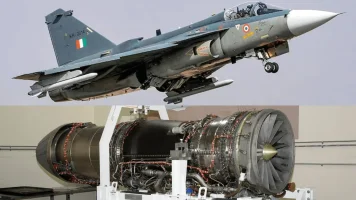
In a significant boost to its aerial combat capabilities, India’s Tejas Mk1A fighter jet has successfully validated a new twin-missile launcher designed to carry the Advanced Short Range Air-to-Air Missile (ASRAAM).
The milestone, achieved following rigorous flight trials conducted last year, marks the finalisation of a critical weapons integration programme led by Hindustan Aeronautics Limited (HAL).
This upgrade substantially sharpens the aircraft’s dogfighting edge while highlighting the growing maturity of India’s indigenous defence ecosystem.
The twin adapter launcher, which first broke cover in imagery displayed at Aero India 2025, is a specialized engineering solution designed to double the missile payload without negatively affecting the jet’s flight characteristics.
The system is mounted on the Tejas Mk1A’s outboard wing station (weapon station 6), a location that requires precise engineering to manage airflow and weight balance.
The new configuration allows a single pylon to securely carry and launch two ASRAAM missiles, optimizing the aircraft for high-stakes, close-range engagements.
Engineering such a system required overcoming significant structural challenges. The ASRAAM, a high-performance infrared-homing missile manufactured by MBDA, weighs approximately 88 kilograms.
The dual launcher is built to sustain a combined load of around 310 kilograms, which includes the missiles, the launcher itself, and necessary interface hardware.
HAL engineers focused heavily on load distribution and reinforcing the pylon to ensure the aircraft retains its full performance envelope—capable of sustaining high-G manoeuvres without risking structural failure or flight instability.
Operationally, this integration offers immediate tactical benefits.
The ASRAAM is renowned for its speed—capable of exceeding Mach 3—and its range of over 25 kilometres, making it lethal in within-visual-range combat.
By carrying two of these missiles on a single hardpoint, the Tejas Mk1A effectively increases its "ready-to-fire" magazine.
Crucially, this frees up other hardpoints on the aircraft for different mission requirements, such as additional fuel tanks, electronic warfare pods, or long-range beyond-visual-range (BVR) weaponry. This flexibility allows pilots to remain in the fight longer and engage multiple threats rapidly.
The validation process involved a complex series of tests to synchronize the mechanical and electrical systems of the new launcher with the aircraft's mission computer.
Engineers had to ensure that the missile’s communication protocols and the jet’s flight control logic worked in perfect harmony to guarantee safe separation during firing.
The successful trials confirm that the indigenous design meets strict safety and performance standards, validating the decision to tailor specific solutions for the Tejas platform rather than relying solely on off-the-shelf imports.
This upgrade represents more than just a hardware addition; it signals a shift toward maximizing combat efficiency through smart integration.
In modern aerial warfare, the ability to carry a higher volume of weapons without significantly increasing drag or weight is a major force multiplier.
The twin ASRAAM capability ensures the Tejas Mk1A remains a potent competitor in close-quarter aerial battles, where reaction times are minimal and the first shot often determines the victor.
As the Tejas Mk1A programme progresses toward full operational networking, such incremental yet impactful upgrades are essential.
The twin launcher transforms the aircraft into a more versatile and heavily armed interceptor, ready to face contemporary threats.
With this validation complete, the Indian Air Force can look forward to a fighter that blends indigenous engineering with world-class weapon systems, enhancing the nation's air defence posture one innovation at a time.