- Views: 3K
- Replies: 12
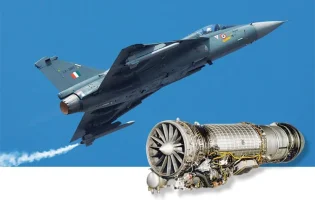
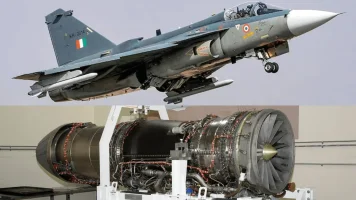
The Tejas Mk1A, India’s advanced light combat aircraft, stands as a significant milestone in the nation's journey towards self-reliance in defence aviation.
With 83 units already on order and approval for an additional 97 aircraft—bringing the potential total to over 180—this platform is set to become the backbone of the Indian Air Force’s (IAF) light fighter fleet.
However, a critical strategic vulnerability remains: the aircraft’s power source, the GE F404-IN20 engine, is entirely imported from the United States, with no plans for licensed manufacturing or significant technology transfer (ToT) to India.
This absolute dependency contrasts sharply with the strategy for the more powerful GE F414 engine, which has been selected for the upcoming Tejas Mk2 and the initial batches of the Advanced Medium Combat Aircraft (AMCA).
For the F414, India is actively pursuing co-production and aims to secure up to 80% technology transfer, highlighting a divergent approach between the current fleet and future platforms.
The Engine Gap
The F404-IN20 is an uprated variant of the original GE F404, delivering approximately 84-85 kN of thrust with an afterburner. It was specifically customised to meet India’s rigorous operational requirements, such as take-offs from "hot-and-high" bases in Ladakh.This engine will power the entire fleet of Tejas Mk1A fighters, which are expected to enter service shortly and remain operational well into the 2050s. This creates a service horizon of over 30 years, similar to the extended lifespans seen in platforms like the MiG-29.
To support this massive fleet, India has secured significant import contracts:
- 2021: A contract for 99 engines valued at ₹5,375 crore.
- November 2025: A follow-on deal for 113 additional engines worth approximately $1 billion, with deliveries scheduled to begin in 2027 and conclude by 2032.
Why No "Made in India" for the F404?
The absence of domestic manufacturing for the F404 stems from a combination of historical timing, strategic prioritisation, and commercial realities.1. Historical Production Gaps
GE had previously halted production of the F404-IN20 after fulfilling the initial orders for the Tejas Mk1 (approximately 65 engines by 2016).With no immediate follow-on orders, the production line went dormant. India’s subsequent decision to order the Mk1A in large numbers—after a delay caused by shifting focus to the Mk2—effectively surprised the manufacturer.
Restarting a closed line is a complex process involving the re-certification of vendors and addressing supply chain disruptions, a challenge compounded by the global pandemic and specific supplier failures, such as those in South Korea.
2. Low Technology Transfer in Legacy Deals
Unlike the 2023 MoU for the F414 engine, which prioritises 80% ToT, past F404 contracts were structured purely for direct supply and support.The F404 is essentially a design from the 1970s; consequently, GE has not offered substantial technology transfer for what is now considered a "legacy" engine, especially as global users transition to newer platforms.
3. Strategic Focus on Next-Generation Engines
Indian planners have prioritised resources for the future.The focus is on the F414 for the Tejas Mk2 and AMCA, where co-production is viable and aligns with the requirement for higher thrust (98 kN).
Investing heavily to localise the older F404 might have diverted critical funds and technical manpower away from advanced initiatives, such as the indigenous Kaveri engine program, which is now targeting 90 kN thrust in collaboration with Safran.
4. GE’s Manufacturing Perspective
While GE restarted the line specifically for India, the ramp-up has been gradual.Projections indicate a delivery rate of 12 engines in 2025, rising to 20 annually from 2026.
There have been no public proposals for Indian manufacturing, likely because GE projects low demand for the F404 engine outside of India after 2032.
Long-Term Strategic Risks
This reliance on direct imports creates several long-term vulnerabilities for the IAF:- Risk of Line Closure: As the F404 family dates back to the 1970s, there is a distinct possibility that GE may mothball or permanently shut down the production line once India’s current orders are fulfilled around 2032.
- Spares and Overhaul Crisis: Fighter engines have finite service lives and require replacement or major overhauls. By the 2040s and 2050s, when the Tejas Mk1A fleet will require hundreds of replacement engines or deep spares support, restarting production could be prohibitively expensive or technically impossible due to supplier obsolescence.
- Geopolitical Vulnerability: The delays experienced in 2024-2025, where the first engine arrived in March 2025 after repeated missed deadlines, underscored the risks. While penalties were invoked, the dependency grants foreign entities significant leverage over the readiness of India’s frontline fighter fleet.
Conclusion
There is a profound irony in India’s current aviation strategy.The engine powering the largest and longest-serving fleet—the F404 in the Tejas Mk1A—should logically have been a priority for localisation to ensure sovereignty over maintenance and spares.
Instead, India is investing heavily in creating an ecosystem for the F414, tailored for platforms that will only mature in the mid-2030s, leaving the current backbone of the IAF exposed to global supply chain volatility for decades to come.