- Views: 3K
- Replies: 1
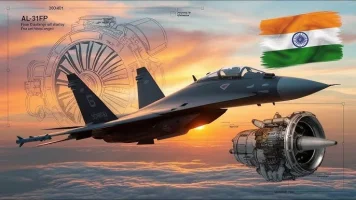
The Defence Research and Development Organisation (DRDO) is making rapid progress on the indigenous Virupaksha radar, a critical component of the Indian Air Force’s (IAF) ‘Super-30’ modernisation programme.
Designed to upgrade the formidable Su-30MKI fleet, this advanced sensor is being specifically tuned to detect stealth aircraft at long ranges, addressing the growing proliferation of fifth-generation fighters in the Asian region.
Advanced Technology for Superior Detection
The Virupaksha is an Active Electronically Scanned Array (AESA) radar built upon Gallium Nitride (GaN) technology.According to sources, the production-ready variant will feature over 2,400 Transmit-Receive Modules (TRMs), making it one of the most powerful fighter-mounted radars in the region.
The shift to GaN technology represents a significant leap over older Gallium Arsenide (GaAs) systems.
GaN offers superior power efficiency and heat tolerance, allowing the radar to emit high-energy pulses over sustained periods. This high-density TRM configuration enables the radar to detect and track targets with a very low Radar Cross-Section (RCS)—specifically stealth fighters—at extended distances.
This is a marked improvement over the current passive electronically scanned array (PESA) radars used by the fleet, offering greater resistance to jamming and faster scanning capabilities.
Breaking the Stealth Advantage
A primary benchmark for the Virupaksha programme is the ability to detect stealth aircraft at ranges exceeding 200 kilometres. The objective is to identify a target with an RCS of just 0.01 m² from a safe standoff distance.Stealth fighters typically rely on a "first look, first kill" strategy, attempting to slip into an adversary's 80-100 km "no-escape zone" undetected. The Virupaksha aims to reverse this dynamic.
DRDO engineers are currently refining signal-processing algorithms to sift through clutter and pick up the faint radar echoes of Very Low Observable (VLO) aircraft, even when those adversaries are flying in "clean" configurations without external fuel tanks or weapons.
Strategic Implications
This capability is strategically vital given the evolving threat matrix in the subcontinent.With China inducting Chengdu J-20 stealth fighters in significant numbers and Pakistan expected to acquire the J-35A (a variant of the FC-31) in the coming decade, the IAF requires a reliable counter-stealth solution.
By detecting these threats at over 200 km, the upgraded Su-30MKI would be able to launch long-range air-to-air missiles, such as the indigenous Astra MkII or Astra MkIII, before the enemy can engage.
This effectively negates the first-shot advantage traditionally held by stealth platforms.
The Super-30 Upgrade
The integration of the Virupaksha radar is part of a broader, comprehensive upgrade for the Su-30MKI, known as the Super-30 programme.This initiative aims to transform the heavy multirole fighter into a high-capability counter-stealth platform, ensuring its operational relevance well into the 2050s.
Alongside the radar, the upgrade package will include advanced indigenous mission computers, new avionics, and a modernized electronic warfare (EW) suite.
This holistic approach ensures that the Su-30MKI remains the backbone of India’s air defence, capable of maintaining a balanced air combat environment against next-generation threats.