- Views: 44
- Replies: 1
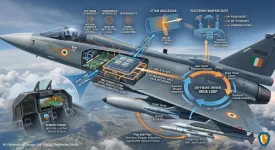
The Omni-Role Combat Aircraft (ORCA) stands out as a fascinating concept within India's domestic fighter development network.
Originally planned by the Aeronautical Development Agency (ADA) as a dedicated land-based version of the Twin Engine Deck Based Fighter (TEDBF) for the Indian Air Force (IAF), it was envisioned as a medium-weight, twin-engine jet.
Its main goal was to bridge the operational gap between the Tejas Mk2 and the fifth-generation Advanced Medium Combat Aircraft (AMCA).
Even though it sparked genuine excitement among aerospace experts in India, the ORCA has not received official government backing or financial support, leaving it stuck in bureaucratic limbo.
Its future remains a topic of intense discussion as the Indian Air Force deals with a shrinking number of fighter squadrons and tries to determine the best path to upgrade its combat forces for the coming decades.
The main idea behind the ORCA is straightforward and strategic. The future of the IAF is largely built around two homegrown platforms: the Tejas Mk2 and the AMCA. While both are crucial to the nation's defence, they serve very different purposes in aerial combat.
The Tejas Mk2 is a single-engine, medium-weight plane designed to replace older jets like the Jaguar, Mirage 2000, and MiG-29.
On the opposite side is the AMCA, a highly advanced fifth-generation stealth fighter built to rival modern radar-evading planes from other global powers. Recent open-source updates indicate that AMCA development is being accelerated, with the program aiming for a prototype rollout and first flight around 2028.
The space between these two fighters is usually filled by twin-engine, 4.5-generation jets like the French-made Rafale. This specific middle ground is exactly where the ORCA was designed to fit.
The demand for this type of aircraft comes from long-standing challenges in the IAF's modernisation plans. The initial effort to buy 126 Medium Multi-Role Combat Aircraft (MMRCA) ended with India purchasing only 36 Rafales directly from France.
A newer initiative to buy 114 Multi-Role Fighter Aircraft (MRFA) has also faced continuous hold-ups due to debates over pricing, domestic manufacturing rules, and the sharing of advanced technology.
ADA suggested leveraging the heavy research and development funds already poured into the naval TEDBF project to create the Air Force version.
By using the same basic aerodynamic design, internal systems, electronics, and factory setups, the ORCA could theoretically be built much faster and cheaper than starting a new aircraft from scratch.
The most important part of this plan was stripping away the heavy equipment specifically needed for aircraft carrier operations.
Navy planes that operate from carriers are built to handle extreme physical stress. Landing on a moving ship creates much harder impacts than landing on a normal runway, so these jets require reinforced landing gear, a much tougher body, special arrestor hooks, and wings that can fold up to save space on deck.
Naturally, all of these extra structural reinforcements make the aircraft significantly heavier.
By removing these specific naval features, the ORCA would go through a "de-navalisation" phase.
Taking out the arrestor hooks, heavy-duty wheels, and wing-folding mechanisms could reduce the plane's overall weight by approximately 1.5 tonnes compared to its naval counterpart.
Losing this extra weight brings a host of distinct performance benefits.
A lighter jet usually has a better thrust-to-weight ratio, meaning it can speed up faster, climb quicker, and maneuver more easily in a dogfight.
The weight saved could also be used to carry more internal fuel for longer missions or to pack a significantly larger payload of weapons.
Ultimately, this would create a jet very similar in class to the Rafale, offering multi-role capabilities, the safety of two engines, top-tier sensors, and the ability to carry heavy loads, all while relying on Indian-made parts.
Despite these clear benefits, the Indian Air Force has not shown much enthusiasm for officially adopting the project.
The biggest problem standing in the way is the development schedule.
The ORCA's timeline is tied directly to the progress of the TEDBF. Recent updates suggest the naval TEDBF's preliminary design is taking time, pushing its expected first flight to 2032 and production closer to 2038.
Because the Air Force version would inevitably follow the naval one, the ORCA would not be ready for actual use until the late 2030s at best.
For an Air Force that is currently operating well below its sanctioned number of fighter squadrons, waiting over a decade does not solve any immediate security challenges.
Another major issue is how to best allocate limited money and resources.
The stealthy AMCA is currently the highest-priority homegrown fighter project for the Indian Air Force.
With China already flying a large number of J-20 stealth fighters and actively developing more advanced aircraft, the IAF believes having its own fifth-generation planes is an absolute necessity to secure the skies in the future.
Starting the ORCA project at the same time would drain essential funding, skilled engineers, testing facilities, and industrial capacity.
Many Air Force leaders worry that focusing on a new 4.5-generation jet could critically slow down the AMCA project just when stealth technology is needed most.
The final factor is practical combat readiness and logistics.
The IAF is already flying the Rafale and has everything established for it, from supply chains and repair procedures to pilot training and weapons integration.
If the Air Force needs more twin-engine, medium-weight fighters soon, buying more Rafales is viewed as a safer and faster choice than pouring money into a developmental jet that will not be ready for years.
All of this leads to a very difficult dilemma for defence planners.
From the perspective of India's domestic industry and its goal of self-reliance, the ORCA makes a lot of sense.
It would deepen the country's aircraft design skills, lower reliance on foreign suppliers, boost local manufacturing, and potentially result in a jet that could be exported to other nations.
However, from the Air Force's perspective, the absolute priority is acquiring proven combat capabilities within acceptable timeframes, while ensuring the vital AMCA project stays completely on track.