- Views: 2K
- Replies: 1
The 2020 Nagorno-Karabakh conflict served as a harsh lesson for the Armenian armed forces. Facing a technologically superior Azerbaijani military equipped with modern drones and precision artillery, Armenia was forced to rely on its older, Soviet-era stockpile for retaliation.
This included Scud-B and OTR-21 Tochka-U systems, which were fired at targets like Ganja, resulting in tragic civilian casualties and international criticism. As the battlefield situation worsened, Yerevan eventually launched its advanced Russian-made Iskander ballistic missiles, a system it had previously held in reserve.
However, these missile strikes were largely neutralised by Azerbaijan's highly advanced air defence shield. Central to this shield is the Israeli-made Barak MX system, developed by Israel Aerospace Industries (IAI).
This modular network, capable of engaging targets up to 150 kilometres away, proved highly effective. During the final days of the 2020 conflict, the Barak system successfully tracked and intercepted an incoming Armenian Iskander missile.
Because the Barak MX uses active radar guidance and rapid-response interceptors, it easily defeated traditional ballistic missiles that follow predictable, high-arching flight paths.
Following the 2020 ceasefire, military planners in Yerevan realised the urgent need for weapons that could bypass modern interceptors. They began looking for missiles capable of changing direction mid-air, making them far more difficult for enemy radar to track.
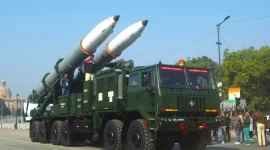
This requirement naturally led Armenia to evaluate India’s Pralay tactical ballistic missile. Designed by India's Defence Research and Development Organisation (DRDO), the Pralay is a highly advanced, surface-to-surface weapon that complies with international export regulations.
The primary advantage of the Pralay is its unique flight profile. Unlike conventional missiles that travel in a predictable arc, the Pralay follows a flatter, "quasi-ballistic" path and can perform evasive manoeuvres as it approaches its target. This makes it incredibly difficult for systems like the Barak MX to calculate an interception point.
Launched from mobile canisters for rapid deployment, the export variant of the Pralay is specifically capped at a 290-kilometre range and a 500-kilogram payload to strictly adhere to the Missile Technology Control Regime (MTCR) limits, while still delivering pinpoint accuracy.
Armenia's interest in the Pralay is part of a rapidly expanding defence partnership with New Delhi.
Having already become a major importer of Indian military hardware—including massive orders for Pinaka multi-barrel rocket launchers, Swathi weapon-locating radars, and Akash air defence systems—Armenia is reportedly in the final stages of negotiations for the Pralay.
If the deal is approved, Armenia will become the first foreign buyer of the missile, giving it a powerful counterweight to the highly accurate Israeli-made LORA ballistic missiles currently fielded by Azerbaijan.
For Yerevan, acquiring the Pralay is fundamentally about restoring strategic balance and rebuilding a military that suffered heavy territorial losses. When an adversary can easily shoot down incoming missiles, the psychological and tactical value of those weapons is lost entirely.
By introducing a manoeuvrable missile that drastically shrinks the reaction time of enemy air defences, Armenia hopes to re-establish a credible deterrent.
Furthermore, India’s willingness to export MTCR-compliant systems aligns perfectly with New Delhi's ambition to become a major global defence supplier.
Ultimately, a successful Pralay deal would cement Armenia's strategic pivot away from its historical reliance on Russian equipment towards a more diversified and modernised military arsenal.