- Views: 2K
- Replies: 1
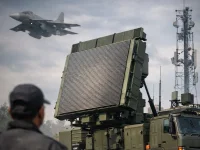
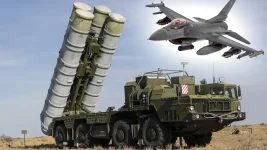
While the imposing missiles of the Russian S-400 Triumf typically command the spotlight, the system’s formidable reputation is truly anchored in its 92N6E "Grave Stone" engagement radar.
In any modern long-range surface-to-air weapon, the underlying battle management technology dictates its success. Without a powerful fire-control radar to detect, filter, track, and guide interceptors all at once, even the fastest missiles are rendered useless.
To ensure India's domestic Project Kusha air defence initiative stands as a true equal—and eventual successor—to the S-400, the Defence Research and Development Organisation (DRDO) and Bharat Electronics Limited (BEL) have undertaken a monumental task.
They are developing an entire radar ecosystem designed to execute one of modern warfare’s most difficult operations: orchestrating a multi-tiered response to simultaneous threats from stealth fighters, cruise missiles, unmanned drones, and ballistic weapons.
This effort has culminated in the Long Range Multi-Function Radar (LR-MFR). This advanced sensor is rapidly taking shape as the central command node of India’s independent strategic air defence network.
Recently, Defence Minister Rajnath Singh lauded Project Kusha as a "game-changer" for national security, noting its critical role within the broader multi-layered "Mission Sudarshan Chakra" shield and its proven efficacy during the 2025 tri-services campaign, Operation Sindoor.
The S-400 Benchmark and Its Strategic Limits
Comprehending the true value of the LR-MFR requires looking at the global standard it aims to surpass.The "Grave Stone" radar of the S-400 stands as one of the most capable fire-control systems active today.
Utilizing a space-fed phased array design—a mature yet highly proficient electronic scanning technology operating in the I/J band—it is known to track around 100 targets at a time.
Furthermore, it can actively engage up to 36 of those threats by simultaneously guiding 72 interceptor missiles.
This massive processing capacity is precisely what transforms the S-400 from a basic missile launcher into a comprehensive, multi-layered strategic barrier.
Based on the size and radar signature of incoming targets, the Grave Stone boasts an impressive operational reach of 300 to 400 kilometres.
By pairing robust signal processing with sophisticated target identification software, the system expertly manages engagements against agile, fast-moving threats, even when facing severe electronic jamming.
Yet, despite these remarkable specifications, the S-400 batteries exported to India present a critical drawback for New Delhi: an inherent reliance on closed-source Russian electronic warfare protocols and software.
For the Indian Air Force (IAF), the system functions largely as a "black box."
Although Indian personnel operate the hardware, they are locked out of its fundamental software architecture, threat databases, and intricate counter-measure algorithms.
Consequently, updating the system to counter emerging electronic warfare tactics or new threat profiles mandates permission and technical assistance from Russia. With electronic warfare advancing at a blistering pace, this technological dependency introduces a significant strategic weakness.
The Technological Leap with GaN AESA
The LR-MFR developed under Project Kusha was explicitly engineered to eradicate this vulnerability.Moving away from traditional space-fed array structures, the LR-MFR incorporates a cutting-edge Active Electronically Scanned Array (AESA) configuration powered by Gallium Nitride (GaN) modules.
Industry updates from early 2026 confirm that DRDO and BEL have successfully pushed these GaN radar modules into the pre-production phase, marking a massive technological leap forward compared to India's older domestic radar systems.
The implementation of GaN technology drastically elevates radar capabilities, offering superior power outputs and thermal management when compared to legacy silicon or gallium arsenide models.
Because these modules operate at cooler temperatures despite managing heavier power loads, the radar achieves enhanced beam flexibility, stronger signal emissions, and much higher resilience against enemy electronic jamming.
These technical upgrades yield immediate benefits on the battlefield. Depending on the nature of the target, the LR-MFR is projected to deliver precise tracking at distances ranging from 250 to 350 kilometres.
Crucially, its AESA framework allows the radar beam to be redirected instantly without any moving physical parts, enabling the system to juggle sweeping, tracking, guiding missiles, and executing electronic warfare in the blink of an eye.
Managing a Three-Tiered Interceptor Family
In a live combat scenario, the LR-MFR functions as the primary cognitive centre for the complete Project Kusha deployment.The sheer difficulty of this command role is highlighted by the diverse arsenal of missiles the system controls.
Diverging from traditional systems tuned for a single type of threat, Project Kusha relies on a trio of interceptor variants.
This three-layered approach is structured to eliminate drastically different adversaries across a multitude of altitudes and distances, with the system slated for phased induction between 2028 and 2030:
- M1 Interceptor: Tailored to neutralize fast tactical targets at distances up to 150 kilometres.
- M2 Interceptor: Pushes the boundary to 250 kilometres, focusing on elusive threats like cruise missiles and stealth fighters.
- M3 Interceptor: A heavy-duty missile designed to strike at ranges up to 400 kilometres, specifically hunting critical enemy assets like aerial refuelling tankers, Airborne Early Warning and Control (AWACS) planes, and incoming ballistic missiles.
The LR-MFR is tasked with maintaining an unbroken lock on approaching enemies while simultaneously tracking friendly interceptors across various distances.
Because each threat has a unique profile—from hypersonic ballistic missiles plunging from the sky to terrain-hugging cruise missiles and aggressively dodging stealth jets—the radar must categorize, prioritize, and assign weapons to each target in mere milliseconds.
The Interception Sequence
This complex interception begins with the mid-course guidance phase.Upon firing, the Kusha missiles keep their internal sensors turned off. Powering them on prematurely would trigger the enemy’s warning systems, giving them precious time to dodge or deploy decoys.
Instead, the LR-MFR silently tracks both the hostiles and the interceptors for the majority of the journey.
Operating through encrypted, high-speed data networks, the radar continuously sends flight-path adjustments to the missiles, guiding them precisely toward the impact zone.
During this time, the LR-MFR might be steering several M1, M2, and M3 missiles toward entirely different targets, instantly recalculating paths if the enemies attempt evasive manoeuvres. Executing this choreography demands lightning-fast data processing with zero lag.
The operation shifts into its second phase during the final moments before impact.
When the interceptor is just kilometres away from its target, the LR-MFR signals it to activate its internal targeting systems.
Based on the specific missile variant, this could engage dual-mode infrared sensors or active radio-frequency seekers built to track reliably despite heavy enemy interference.
In this final sprint, the missile becomes fully autonomous—a state commonly known in aviation circles as "going pitbull." The interceptor relies entirely on its own sensors to secure the lock and complete the lethal strike.
This delegation is vital because it relieves the LR-MFR from maintaining its lock on that specific engagement. The radar is instantly freed up to focus its processing power on spotting new inbound threats or guiding the next volley of missiles during a massive, coordinated enemy attack.
True Algorithmic Sovereignty
However, the most profound edge the LR-MFR holds over the S-400’s Grave Stone isn't found in its hardware components. It lies entirely in algorithmic independence.Because the radar hardware, the overarching Command, Control, Communications, Computers, and Intelligence (C4I) networks, and the battle management software are all domestically produced, India assumes absolute authority over its electronic warfare capabilities.
Should adversaries deploy novel drone swarm tactics, advanced stealth designs, or new electronic jamming techniques, DRDO and the IAF can immediately rewrite the radar’s counter-measure algorithms and threat-response codes.
They will no longer have to wait for foreign vendors to patch their security, securing a future of true defensive autonomy for the nation.