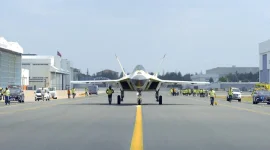
India’s strategic move to embrace an execution model involving public-private collaboration for the Advanced Medium Combat Aircraft (AMCA) represents a watershed moment in the nation's defence manufacturing history.
Approved by the Defence Minister in May 2025, this framework departs from the traditional reliance on state-owned entities by equally empowering private aerospace firms.
For strategic observers in Pakistan, this fundamental shift is more than just a procurement update; it clearly illustrates New Delhi’s resolve to forge a robust, scalable industrial base capable of sustaining future generations of military aviation.
While the AMCA—India’s indigenous fifth-generation stealth fighter—remains spearheaded by the Aeronautical Development Agency (ADA) alongside the Defence Research and Development Organisation (DRDO), the Ministry of Defence’s invitation to private players has caught the attention of the entire region.
The government is actively establishing a new prototype production and testing facility near Puttaparthi, Andhra Pradesh. Integrating private and public sectors into prototype development and full-scale production ensures a level playing field and promises to revolutionise the domestic aerospace landscape.
Historically, defence analysts in Islamabad have pointed to bureaucratic hurdles and production bottlenecks within India's state-owned enterprises as major weaknesses.
They frequently highlighted past delays in projects like the Light Combat Aircraft (LCA) Tejas, suggesting that it would take New Delhi several decades to field a meaningful number of advanced, homegrown combat jets.
However, the AMCA's modern execution model completely changes this narrative. By distributing manufacturing duties across a diverse and competitive industrial base, India is mitigating past delays.
Corporate giants with proven aerospace pedigrees, such as Tata Advanced Systems Limited (TASL) and Larsen & Toubro (L&T), have emerged as prime contenders.
Over the last decade, these firms have heavily invested in precision manufacturing, stealth composites, systems integration, and advanced avionics, making them fully capable of handling such sophisticated requirements.
From Islamabad’s viewpoint, the true threat lies not just in the stealth characteristics of the AMCA, but in the sprawling industrial machinery backing it.
A diversified network of aerospace manufacturers will drastically accelerate production timelines and secure supply chains by removing the reliance on a single organisation.
Furthermore, this ecosystem guarantees that India can maintain high-volume military production during potential periods of intense operational necessity.
Modern military strategy has evolved beyond simply comparing individual weapon systems, a reality increasingly acknowledged by Pakistani defence experts.
Today, domestic technological capacity, scalable manufacturing, and industrial resilience are just as critical for determining long-term military supremacy.
A mature aerospace sector that can indigenously produce drones, advanced avionics, jet engines, and precision-guided weapons offers India sweeping strategic advantages far beyond the AMCA itself.
This shifting paradigm has deeply influenced Pakistan’s own long-term strategic calculations. To maintain technological parity as the AMCA progresses, Islamabad has aggressively pursued its own fifth-generation acquisitions.
Recent reports from mid-2026 indicate that the Pakistan Air Force is advancing plans to procure Chinese J-35A stealth fighters.
The induction of these jets, potentially alongside advanced Chinese airborne early warning systems like the KJ-500, highlights Pakistan’s urgency to establish a modern combat ecosystem before India's stealth fleet becomes fully operational.
Beyond China, Pakistan has also formally expressed a strong interest in participating in Turkey’s KAAN fifth-generation fighter initiative.
Ongoing discussions regarding potential industrial cooperation with Ankara underscore Islamabad’s broader ambition to diversify its defence partnerships and gain direct access to next-generation aviation technologies without solely relying on Beijing.
Nevertheless, pursuing multiple advanced stealth platforms simultaneously introduces enormous financial hurdles.
Defence economists highlight that funding both the J-35 procurement and the KAAN project, while concurrently modernising existing fleets of JF-17s and J-10CEs, will place severe strain on Pakistan's defence budget.
The initial sticker price of these fighters is only a fraction of the total cost; maintaining fifth-generation aircraft requires continuous investments in specialised logistical infrastructure, stealth maintenance facilities, pilot training, and long-term lifecycle support.
Despite acknowledging India’s industrial strides, observers in Pakistan continue to highlight potential roadblocks for the AMCA, primarily focusing on engine dependency.
The initial AMCA Mk1 variant will be powered by American GE F414 engines, while India seeks a more powerful indigenous or jointly developed engine for the Mk2 variant.
Recent delays in GE engine deliveries for the Tejas Mk1A have amplified regional doubts regarding supply-chain reliability and the inherent risks of relying on foreign propulsion technology.
To resolve this for the future, India is reportedly working to clear a joint venture between the Gas Turbine Research Establishment (GTRE) and France's Safran for a high-thrust AMCA Mk2 engine.
Securing a reliable powerplant remains the most critical hurdle for any advanced fighter project globally. Even nations with highly mature aerospace industries frequently rely on international joint ventures for jet propulsion.
Consequently, Pakistani analysts argue that the AMCA's timeline will remain firmly tied to the timely delivery of foreign engines until a completely indigenous or co-developed alternative is fully operational.
Another point of scrutiny is the practical difficulty of rapidly expanding private aerospace manufacturing. While corporations like TASL and L&T boast exceptional engineering backgrounds, establishing an end-to-end production line for a fifth-generation fighter is a monumental task.
It necessitates years of sustained investment in advanced composite manufacturing, stealth material processing, precision machining, rigorous quality assurance, and the training of a highly specialised workforce.
Such an intricate industrial base cannot be manifested overnight. Aerospace manufacturing demands unforgiving certification standards and inherently lengthy development cycles.
Therefore, commentators in Pakistan assert that while involving the private sector will certainly inject momentum into the AMCA programme, it cannot magically erase the immense technical and industrial complexities associated with fielding a stealth fighter.
Still, India’s broader developmental trajectory is unmistakable. Driven by the Atmanirbhar Bharat (Self-Reliant India) initiative, New Delhi has systematically integrated the private sector across its defence spectrum over the past decade.
Private enterprises are now key players in manufacturing electronic warfare systems, radars, missiles, artillery, naval vessels, and space technology.
The AMCA simply represents the logical evolution of this self-reliance policy entering the most technically demanding domain of military aviation.
Ultimately, for Pakistan, the implications stretch far beyond the deployment of a new stealth fighter by its neighbour.
If India successfully cultivates a globally competitive aerospace ecosystem—one capable of independently designing, producing, and maintaining next-generation combat aircraft—it will cement New Delhi’s long-term strategic autonomy and permanently insulate its defence forces from external supply chain disruptions.