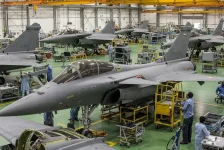
A recent strategic assessment by French military experts has raised critical questions regarding the Dassault Rafale's ability to dominate against genuine fifth-generation stealth aircraft.
According to a January 2025 report titled "The Future of Air Superiority" published by the French Institute of International Relations (Ifri), French fighter pilots acknowledge that achieving victory against mature stealth platforms in allied combat exercises is exceptionally difficult.
This operational reality, voiced directly by pilots operating the same aircraft type utilised by the Indian Air Force, carries significant implications as India advances its procurement of 114 Multi-Role Fighter Aircraft (MRFA).
The study, authored by French Air and Space Force Lieutenant Colonel Adrien Gorremans and Jean-Christophe Noël, provides a candid evaluation of current air combat dynamics.
The authors highlight that while radar stealth alone does not guarantee dominance, its absence leaves the French air fleet at a disadvantage.
In multinational operations with partners equipped with stealth platforms like the American F-35, the study predicts a "two-speed coalition."
In this scenario, fourth-generation fighters like the Rafale are relegated to auxiliary support roles, while fifth-generation jets lead the primary combat missions.
Such an admission is particularly notable because it originates from within the French military establishment itself, rather than from rival aerospace manufacturers seeking to diminish the aircraft's reputation.
The Indian Perspective and the Chinese J-20
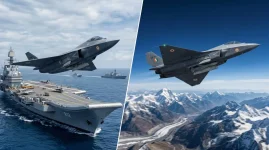
In contrast to the French study's cautionary tone, Indian defence officials have consistently expressed strong confidence in the Rafale, particularly when comparing it to China's Chengdu J-20.Former Indian Air Force Chief RKS Bhadauria previously noted that Beijing deployed J-20s near the Galwan sector immediately following India's induction of the Rafale, indicating that China views the French fighter as a serious threat.
Furthermore, military analysts and retired officers have frequently questioned the J-20's classification as a genuine fifth-generation fighter due to persistent uncertainties regarding its domestic WS-15 engines, radar cross-section, and electronic warfare suites.
The IAF also emphasises the Rafale's extensive combat pedigree over the last 25 years in theatres such as Afghanistan, Libya, Mali, and Syria—a track record of proven operational experience that stands in stark contrast to the untested history of the Chinese J-20.
Evaluating the Threat Environment
This contrast in perspectives prompts a crucial strategic question: Will the Rafale effectively counter China's premier fighters, or will it ultimately fall short against advanced stealth technology?The reality likely encompasses both scenarios, depending heavily on the specific adversary.
The Ifri study evaluates the Rafale against fully matured, sensor-fused stealth aircraft operating within a highly structured NATO environment with flawless data link integration.
Conversely, India's optimism is rooted in scepticism regarding the actual capabilities of the J-20.
It is entirely plausible that the Rafale would struggle against a perfected stealth fighter in ideal conditions, yet remain highly capable against a Chinese fleet whose stealth materials, engine reliability, and avionics are still considered unproven by many global defence experts.
However, basing a major strategic procurement on the assumption that China's stealth aviation programme will permanently remain underdeveloped presents a significant risk for Indian military planning.
Shaping the 114-Jet MRFA Deal
This dynamic is central to the ongoing negotiations for India's 114-jet MRFA programme, a deal estimated to be worth tens of billions of dollars.Dassault Aviation recognizes the limitations of the Rafale's traditional stealth profile and has shifted its technological strategy. The advanced F4+ and forthcoming F5 variants are not pitched as direct stealth competitors to the J-20 in terms of radar cross-section.
Instead, open-source reports indicate that the F5 standard, expected to enter service in the 2030s, is being promoted as a networked flying command centre.
This variant will heavily feature integrated artificial intelligence and the ability to control unmanned systems, such as the Dassault nEUROn loyal wingman drones, to manage dense electronic warfare environments.
Indian defence planners must now critically assess whether this network-centric, drone-assisted approach genuinely bridges the capability gap identified by French pilots, or merely masks a structural disadvantage in the face of true fifth-generation adversaries before committing to the MRFA acquisition.