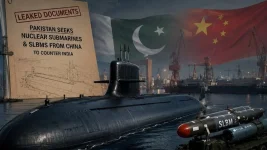
A major setback to Pakistan's nuclear deterrence goals has emerged, as China has reportedly denied a request to help Islamabad build a sea-based nuclear second-strike force.
Recent leaks of Pakistani diplomatic cables and military records reveal that during talks in 2024, Pakistan asked Beijing for critical nuclear submarine technology.
In return for this assistance, Islamabad proposed granting the Chinese military permanent and expanded control over the strategic deep-water port of Gwadar in Balochistan.
If successful, this technology would have completed Pakistan's nuclear triad—the ability to launch nuclear weapons from land, air, and sea.
This urgent appeal to China was largely driven by ongoing technical hurdles within Pakistan's own missile programmes.
For years, Islamabad has attempted to modify its conventional French-origin Agosta-90B diesel-electric submarines to carry the Babur-3 submarine-launched cruise missile (SLCM).
However, this initiative has encountered severe operational limitations, preventing Pakistan from securing a truly reliable underwater deterrent.
Consequently, Pakistani authorities sought direct transfers of nuclear-powered submarines and submarine-launched ballistic missiles (SLBMs) from China.
Beijing ultimately rejected the proposal, labelling the request as unreasonable due to the dangers of triggering a nuclear arms race in South Asia and violating international non-proliferation agreements.
Beijing's decision exposes the boundaries of the often-celebrated partnership between China and Pakistan.
Although China is a crucial defence supplier for Pakistan—currently fulfilling an order for eight conventional Hangor-class diesel-electric submarines—it remains unwilling to share sensitive, world-class nuclear technologies that could provoke global sanctions and severe regional instability.
Furthermore, the failure to finalise the militarisation of Gwadar port highlights underlying tensions between the two nations.
These strains are amplified by mounting economic challenges, unpaid debts, and increasing security risks to Chinese nationals working on infrastructure projects within Pakistan.
Meanwhile, India is steadily expanding its own underwater nuclear capabilities through self-reliance.
Under its Advanced Technology Vessel programme, New Delhi has successfully developed the Arihant-class of nuclear-powered ballistic missile submarines (SSBNs), including the operational INS Arihant and INS Arighaat.
The recent progress and sea trials of newer vessels demonstrate India's commitment to maintaining a robust and independent nuclear triad.
This self-sufficiency ensures that India has a secure, survivable force capable of deterring potential adversaries in the region.
Defence experts see China's refusal as a calculated choice to stay out of a direct nuclear rivalry between India and its neighbours.
For Pakistan, the denial is a harsh reminder of the widening capability gap in the Indian Ocean.
While India continues to independently strengthen its strategic maritime forces, Pakistan is left to rely on its constrained, conventionally powered submarines and the problematic Babur-3 missile.
Without foreign technological intervention, Islamabad continues to struggle to establish a balanced and effective maritime nuclear deterrent.