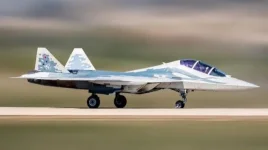
Moscow has significantly accelerated its campaign to secure India as a primary buyer for its fifth-generation Su-57E stealth fighter.
The comprehensive proposal features a massive procurement and domestic production plan, alongside the aircraft’s highly advanced combat network, featuring the next-generation R-77M Beyond-Visual-Range Air-to-Air Missile (BVRAAM).
Recent open-source reports indicate that Russia’s recent unveiling of a new twin-seat variant—dubbed the Su-57D—could make this offer even more attractive to New Delhi, which has long preferred dual-crew fighters for complex combat missions and drone-teaming operations.
According to recent reports, the proposal outlines an immediate off-the-shelf purchase of 40 to 60 Su-57E jets to quickly boost the Indian Air Force's capabilities.
If the Ministry of Defence greenlights the deal, this initial batch would pave the way for the licensed manufacturing of at least 100 more units within India, utilizing existing infrastructure to align with domestic manufacturing goals.
This sweeping package is viewed as a strategic move to reinvigorate the historic military aviation partnership between New Delhi and Moscow.
More importantly, it offers India an immediate, powerful deterrent against the growing fleet of stealth fighters in the region, including China's J-20 and Pakistan's anticipated stealth jet acquisitions.
Defence analysts note that the Su-57E could serve as a vital interim capability to maintain air superiority while India's indigenous Advanced Medium Combat Aircraft (AMCA) program matures toward its expected arrival in the 2030s.
A standout feature of the Russian pitch is the inclusion of the R-77M BVRAAM, a cutting-edge aerial weapon explicitly developed for the Su-57 ecosystem.
Built to fit seamlessly within the fighter's internal weapons bays to preserve its low radar profile, the R-77M represents a massive leap over previous models.
It is specifically engineered to defeat high-speed, agile threats and outmatch rival regional missile systems.
The technological core of the R-77M is its innovative dual-pulse solid-fuel rocket motor.
While traditional beyond-visual-range missiles burn through their fuel in one continuous phase, the R-77M smartly distributes its thrust.
The first engine pulse propels the missile into the thinner air of high altitudes, allowing it to glide efficiently and conserve energy over long distances.
As the missile closes in on its target, it triggers the second propulsion pulse.
This terminal-stage thrust is crucial; while standard missiles lose speed and turning ability at the end of their flight, the R-77M retains maximum maneuverability.
This ensures it can successfully chase down modern fighters executing violent, high-G evasive maneuvers at the edge of its range.
Under ideal launch conditions, the R-77M can strike targets at distances approaching 200 kilometers.
By saving its kinetic energy for the final strike, the missile drastically enlarges its "No-Escape Zone"—the critical distance within which an enemy aircraft cannot survive through speed or evasive flying alone.
This potential acquisition perfectly complements India’s ongoing efforts to heavily arm its existing fighter squadrons.
The Indian Air Force is already actively pursuing the ultra-long-range Russian R-37M hypersonic missile for its Su-30MKI fighters.
With an operational range spanning 300 to 400 kilometers, the R-37M is widely dubbed an “AWACS killer.”
It is specifically tailored to destroy vital enemy support assets—such as airborne early warning planes, mid-air refuelers, and electronic warfare platforms—long before they can coordinate an attack against Indian forces.