The transition from older Gallium Arsenide (GaAs) to modern Gallium Nitride (GaN) materials in missile tracking systems is a monumental leap for India's upcoming arsenal.
Although less visible than rocket motors or outer shells, the radar seeker dictates success in highly contested skies.
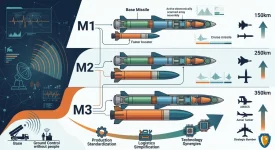
For advanced platforms like the air-to-air Astra Mk2 (capable of striking targets between 200 to 240 kilometres away) and the air-to-surface Rudram-III (a heavy anti-radiation missile with a massive 550 to 600 km range), this new seeker technology is crucial.
GaN fundamentally transforms how these missiles identify and lock onto targets despite intense enemy jamming, bringing India’s aerial combat capabilities on par with top global military powers.
From a scientific standpoint, GaN possesses a much wider "bandgap" of roughly 3.4 electron-volts (eV). This allows the material to handle far greater electrical voltages, temperatures, and power levels compared to older GaAs technology.
In practical application, this gives radar seekers a five to ten times boost in power density. Instead of a standard radar emission, the seeker becomes an incredibly high-intensity energy source that can easily overpower enemy electronic countermeasures (ECM).
When hostile forces try to hide their aircraft using electronic noise or decoy signals, this immense power allows the missile to achieve "burn-through," effectively piercing the jamming interference to reveal the true target and maintain a steady lock.
Another major benefit is how the material handles extreme heat. Traditional GaAs components lose efficiency as temperatures climb, which is a severe flaw for missiles travelling at speeds over Mach 3 where intense friction causes internal heating.
GaN, however, effortlessly sustains peak performance even when internal temperatures soar past 250°C. Because it is naturally resilient to heat, engineers can shrink the cooling mechanisms inside the weapon.
This saved space and energy can then be used to install larger, more sophisticated sensors. Consequently, developers achieve a much better balance of size, weight, power, and cost (known as SWaP-C) without compromising the missile's deadly precision.
Furthermore, GaN offers unmatched flexibility across a wide spectrum of radar frequencies. This capability allows the missile’s seeker to rapidly and efficiently jump between different frequencies in mid-air—a tactic known as frequency hopping.
If an enemy attempts to jam a specific radar band, the seeker instantly switches to an alternative frequency to keep its lock on the target intact.
This extreme agility is critical for overcoming modern Digital Radio Frequency Memory (DRFM) jammers, which are designed to anticipate and overwhelm specific radar signals.
The ability to process a broad range of frequencies also paves the way for advanced multi-mode seekers. Future missiles will increasingly combine traditional active radar with passive imaging infrared (IIR) technology.
Because GaN can manage high-frequency data so quickly, it allows both sensor types to operate simultaneously and process targeting information in real time. As a result, adversaries cannot easily spoof the missile, as defeating one sensor will not stop the other from guiding the weapon to a direct hit.
On the manufacturing front, successfully producing GaN technology within India is a massive strategic victory. Historically, advanced GaN modules have been heavily restricted by global export controls to prevent technology transfer.
Following past instances where foreign nations denied essential radar technology, Indian scientists pushed for indigenous solutions.
Thanks to the Defence Research and Development Organisation (DRDO), specifically the Solid State Physics Laboratory (SSPL) in Delhi and the Gallium Arsenide Enabling Technology Centre (GAETEC) in Hyderabad, India has bypassed these foreign dependencies.
Manufacturing these chips locally guarantees that upcoming projects, like the 350-kilometre range Astra Mk3 (Gandiva), will not be delayed by international supply chain issues or political embargoes, while also enabling faster design upgrades.
Comparing the two eras of missile technology reveals a stark contrast. While older seekers offered limited power and were vulnerable to modern electronic warfare, GaN-equipped missiles boast superior energy output, remarkable heat resistance, and highly effective electronic counter-countermeasures (ECCM).
With longer detection ranges and a vastly improved ability to lock onto threats, these weapons pose a credible danger to even the most advanced adversaries.
In tense operational theatres like the Line of Actual Control, where electronic warfare is constantly evolving, this upgrade is nothing short of revolutionary.
Today, aerial warfare is as much an invisible battle of electronics as it is about explosions, and mastering the ability to track a target through heavy jamming is what ultimately decides a mission's success.