- Views: 2K
- Replies: 3
As the Defence Research and Development Organisation (DRDO) moves forward with the execution phase of its Netra Mk2 Airborne Early Warning and Control (AEW&C) system, comparisons with the Boeing E-7A Wedgetail are naturally emerging.
The Wedgetail is widely considered the world standard for modern, narrow-body early warning aircraft.
While both of these sophisticated "eyes in the sky" are built upon the foundations of commercial, single-aisle passenger planes to conduct similar aerial surveillance missions, they represent two very different engineering mindsets.
These differences are driven by distinct tactical needs, varying industrial capabilities, and alternative approaches to technology.
Airframe: Airbus A321 vs Boeing 737
The Netra Mk2 is taking shape on the Airbus A321 platform. Six former Air India commercial jets are currently being converted by AI Engineering Services Limited (AIESL).Following this initial modification, the complex integration of mission systems will be handled jointly by DRDO’s Centre for Airborne Systems (CABS) and Adani Defence Systems & Technologies Limited. The overall development project is valued at roughly ₹10,990 crore (US$1.1 billion).
The Airbus A321 boasts one of the most spacious cabins among single-aisle jets, providing significantly more internal room than the Boeing 737.
This extra capacity allows India to install more operator consoles, additional mission hardware, and better rest areas for the crew, while leaving plenty of room for future technological upgrades.
Furthermore, the A321's robust payload capacity and superior electrical power generation are highly beneficial for supporting advanced, energy-intensive radar and electronic warfare systems.
In contrast, the Boeing E-7A Wedgetail uses a heavily modified Boeing 737 Next Generation airframe, blending the fuselage of a 737-700 with the reinforced wings of a 737-800.
Even though it is physically more compact than the A321, the Wedgetail draws on decades of proven flight operations, an extensive worldwide logistics network, and a reputation for extreme reliability.
The E-7 has already earned its stripes in active service with the air forces of Australia, Turkey, and South Korea, and it is currently being acquired by the United States and the United Kingdom. This gives the Wedgetail an unparalleled track record of operational success among modern early warning aircraft.
Radar Architecture: Different Solutions to the Same Mission
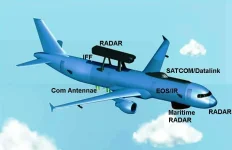
The most striking difference between the two planes is how they handle radar surveillance.The E-7A Wedgetail uses a Multi-role Electronically Scanned Array (MESA) radar developed by Northrop Grumman, which is housed in a unique "Top Hat" structure on the aircraft's spine.
Unlike older radar dishes that spin mechanically, the MESA system relies on fixed Active Electronically Scanned Array (AESA) technology.
It features two large side-facing panels that each cover about 120 degrees, while smaller arrays at the front and back of the antenna cover the remaining 60 degrees forward and backward.
This clever layout gives the Wedgetail a complete 360-degree view of the airspace without any moving external parts.
In addition to tracking aircraft, the MESA radar is equipped with highly advanced Electronic Intelligence (ELINT) capabilities. This allows the Wedgetail to detect and analyse enemy radar signals from long distances.
The Netra Mk2, on the other hand, embraces a different structural philosophy.
Instead of a single, all-encompassing dorsal radar, DRDO has opted for a split-antenna setup. The aircraft features a large AESA radar mounted on its back, supplemented by an additional radar array placed in the nose of the plane, which together provide roughly 300 degrees of active radar coverage.
This nose-mounted radar is specifically designed to eliminate blind spots directly in front of the aircraft, boosting its ability to detect threats while flying toward a target area.
When paired with India's heavily customised, homegrown Electronic Intelligence (ELINT) and Communications Intelligence (COMINT) systems, this setup is fine-tuned for the unique tactical challenges of the Indian subcontinent.
While the Netra Mk2 might not offer the full 360-degree vision of the E-7, its design is a calculated choice.
It highlights DRDO's strategy of balancing high-end capabilities with manageable technical complexity, ensuring the project can be developed domestically within budget and timeline constraints. The delivery of the first such Mk2 aircraft is expected around 2026 to 2027.
Mission Systems and Network Integration
How the crew operates inside the aircraft also varies greatly.The E-7 Wedgetail typically houses around 10 mission consoles and is managed by a crew that includes two pilots and up to 10 mission specialists.
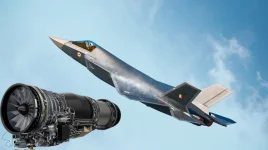
It is designed to plug effortlessly into NATO's standard communication networks, such as Link 16, allowing it to work directly with advanced stealth fighters like the F-35 Lightning II.
Ultimately, the Wedgetail acts as a premier flying command centre, seamlessly orchestrating fighter jets, naval ships, and ground troops across massive combat zones.
The Netra Mk2, however, is being tailor-made for the specific operational doctrines of the Indian Air Force.
Its flexible operator stations are designed to link directly into India's Integrated Air Command and Control System (IACCS). This ensures flawless communication with both domestically produced and imported air defence weapons.
The entire mission suite is built to tackle India’s specific regional threats, which include hard-to-detect drones, incoming cruise missiles, and the potential presence of stealth aircraft along its western and northern borders.
To accomplish this, each A321 airframe will be packed with over a hundred indigenous sensors, antennas, and electronic warfare systems.
Industrial Ecosystem
The industrial backing behind these two aircraft is fundamentally different.The Wedgetail relies on Boeing’s massive, well-established global supply chain and the deep support networks of major Western defence contractors.
In contrast, the Netra Mk2 is a landmark project for India's domestic aviation industry.
The physical modification of the aircraft is led by AIESL, while Adani Defence Systems & Technologies Limited acts as the primary partner for integrating the complex mission systems.
Crucially, Adani is also contracted to provide lifecycle support for 30 years, covering maintenance, repair, and overhaul. This framework ensures that essential maintenance, future upgrades, and logistical support will always remain firmly within India's domestic economy.
A Different Benchmark
While it is natural to compare the Netra Mk2 to the E-7 Wedgetail, the Indian aircraft is not meant to simply copy the Western design.Rather, it embodies India’s broader strategy: building a highly capable, indigenous surveillance aircraft that fits its specific military needs while heavily boosting its own defence industry.
The Boeing E-7 Wedgetail stands as the most mature, combat-tested narrow-body early warning aircraft in the world today, boasting a full 360-degree radar, a global support network, and unmatched battlefield experience.
Meanwhile, the Netra Mk2 aims to utilize the larger Airbus A321 frame, specialized homegrown AESA radars, deep integration with Indian communication networks, and localized intelligence systems to guarantee a truly sovereign "eye in the sky" for the nation's defence.