- Views: 1K
- Replies: 1
The Defence Research and Development Organisation (DRDO) is nearing a major turning point for its Supersonic Missile-Assisted Release of Torpedo (SMART) project.
Sources closely associated with the initiative indicate that the final phase of developmental testing is scheduled to take place later this year.
This long-range, canister-launched anti-submarine warfare (ASW) system is currently in its ultimate development stage, bringing India one step closer to fielding one of its most sophisticated, locally designed naval armaments.
Over the past few years, the project has matured considerably through a sequence of successful test launches.
Should the forthcoming trials confirm that the remaining operational benchmarks have been met, the SMART system will transition into user evaluation trials conducted by the Indian Navy.
Once these final assessments are cleared, the weapon can officially enter the manufacturing phase.
A Standoff Strike Capability
SMART is a unique hybrid weapon that merges the swiftness of a supersonic missile with the underwater striking capabilities of a lightweight, acoustic-homing torpedo.Traditional torpedoes launched from ships are constrained by their slow speeds through the water.
In contrast, this system allows naval forces to target enemy submarines from a standoff distance of up to 643 kilometres (400 miles)—far beyond the reach of the adversary's own submarine-launched weapons.
The payload itself is an advanced lightweight torpedo, known as the Torpedo Advanced Light (TAL) or Shyena, which carries a 50-kilogram high-explosive warhead and has an underwater range of roughly 20 kilometres.
This new system gives the Indian Navy the ability to swiftly neutralise hostile submarine threats detected by maritime patrol aircraft, helicopters, or underwater sensor arrays.
Because of its tremendous range, Indian warships and coastal defence batteries will not need to risk moving closer to an enemy submarine to launch an attack.
How the Hybrid System Works
The weapon operates in two distinct phases:- Missile Flight: After being fired from a mobile truck-based launcher or a ship-based canister, the missile is propelled by a two-stage solid rocket motor to supersonic speeds. It navigates towards the target zone using a precision inertial navigation system with two-way data links for mid-course updates.
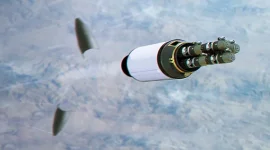
- Torpedo Deployment: Upon reaching the designated drop point, the missile sheds its nose cone and releases the lightweight torpedo, which safely descends to the ocean surface using a specially designed parachute system to reduce its velocity.
It then independently searches for, tracks, and attacks the enemy submarine. This two-step process dramatically cuts down the time it takes to deliver a torpedo to a suspected threat area, keeping Indian vessels safely out of harm's way.
Path to Production
The SMART project has shown consistent success in previous tests.During its fifth successful flight trial on May 1, 2024, conducted from Dr APJ Abdul Kalam Island off the Odisha coast, researchers validated crucial mechanisms.
These included the missile's flight trajectory, velocity control, canister ejection, stage separation, and the complex torpedo deployment process.
Those achievements lowered technical risks and opened the door for this final system qualification phase.
The development is a collaborative effort involving various DRDO laboratories, including the Defence Research Development Laboratory (DRDL) and the Naval Science and Technological Laboratory (NSTL).
According to insiders, the upcoming trials will concentrate on proving the weapon's entire operational sequence in real-world conditions.
These tests will likely assess the missile's flight stability, the precision of the torpedo's release, its seamless entry into the water, the functionality of the seeker, and its overall success in engaging simulated submarine targets.
Upon the successful conclusion of these developmental tests, DRDO will hand the system over to the Indian Navy for user evaluation.
During this phase, naval personnel will test the weapon's real-world performance, how easy it is to handle, and how well it integrates with existing frontline ships and networks.
It is anticipated that the Navy will carry out one or two rounds of these trials before granting final clearance for mass production.
Strategic Impact in the Indian Ocean
If the current timeline holds, the SMART system could officially begin joining the naval fleet around 2031.This timeline will provide the Indian Navy with a formidable, long-range weapon to strike submarines operating across the Bay of Bengal and the Arabian Sea.
Adding SMART to the arsenal will vastly improve India's multi-layered anti-submarine capabilities, which is crucial given the rising presence of foreign submarines in the Indian Ocean Region, particularly from the Chinese Navy.
With modern diesel-electric and nuclear submarines becoming increasingly stealthy and hard to track, having a weapon that can strike rapidly over long distances is vital for the nation's maritime defence.
The new weapon will work alongside India's existing anti-submarine assets, such as the P-8I Poseidon maritime patrol aircraft, MH-60R Seahawk helicopters, and various ship-mounted and towed sonar systems.
By extending the reach of lightweight torpedoes by hundreds of kilometres, surface ships can instantly react to submarine threats while remaining safely out of range.
Ultimately, the SMART initiative highlights DRDO's advancing capability to create highly complex, hybrid weapon systems that fuse missile and torpedo technologies.
By relying on homegrown propulsion, guidance, and underwater weapon systems, SMART marks a massive leap forward in India's quest for self-reliance in advanced defence technology.