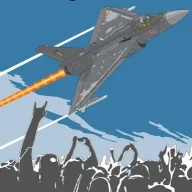
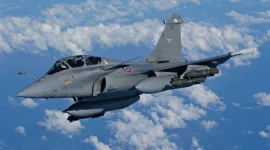
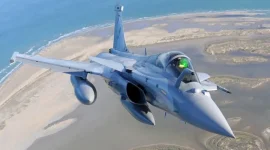
Elite TACDE Unit May Receive Tejas Mk2 Early Production Models to Refine Network-Centric and BVR Capabilities

Elite TACDE Unit May Receive Tejas Mk2 Early Production Models to Refine Network-Centric and BVR Capabilities


India’s highly anticipated medium-weight fighter, the HAL Tejas Mk2, is advancing toward a critical new phase that will define its combat role within the Indian Air Force (IAF).

Hindustan Aeronautics Limited (HAL) has recently proposed providing a limited initial batch of the aircraft to the IAF.

According to defence sources, this move would allow the military to induct a baseline squadron early on, speeding up the process of developing operational tactics and combat guidelines before mass manufacturing begins.

Under this proposed strategy, a small number of early production airframes—likely between six and eight jets—would be handed over for active service. The decision to proceed hinges on the developmental progress of the Tejas Mk2.

If greenlit, these initial jets will be stationed with the Tactics and Air Combat Development Establishment (TACDE), a premier IAF institution based in Gwalior that operates similarly to the famous "Top Gun" school, focusing exclusively on aerial warfare strategies.

This strategy is a common practice among leading global air forces, which often introduce advanced fighters in limited numbers to perfect combat maneuvers while the final developmental tweaks are still underway.

For India, integrating the Tejas Mk2 into TACDE early on ensures that the military knows exactly how to deploy the aircraft effectively in real-world combat long before standard squadrons receive them.

Within the IAF's broader testing framework, different divisions handle distinct phases of an aircraft's evaluation.

While the Aircraft and Systems Testing Establishment (ASTE) is tasked with checking the jet's fundamental flight safety, mechanical performance, and system reliability, TACDE is strictly focused on the battlefield. Its sole mission is to determine how the fighter performs in simulated dogfights and complex wartime scenarios.

Should the induction go as planned, elite TACDE pilots will push the Tejas Mk2 to its limits to test its upgraded design.

The Mk2 features significant structural and technological enhancements over its predecessor, including a heavier payload capacity of up to 6,500 kg powered by a robust General Electric F414 engine, close-coupled canards for agility, and a new Infrared Search and Track (IRST) system.

These additions are designed to give pilots better maneuverability and superior target detection in hostile airspace.

Through rigorous mock battles, TACDE will author the official tactical manual, or "playbook," for the Tejas Mk2. Pilots will execute complex two-on-two and four-on-four aerial drills, refine electronic warfare responses, and map out protocols for Beyond Visual Range (BVR) missile combat.

A crucial part of TACDE’s mission will be testing the array of advanced indigenous weapons the jet is slated to carry.

The early baseline models are expected to be armed with the Astra Mk1 air-to-air missile, but the unit will also prepare the platform for future integration of the longer-range Astra Mk2 and the Rudram anti-radiation missile.

During this phase, pilots will calculate the "Launch Success Zones" for these weapons—identifying the exact speeds, altitudes, and distances required to guarantee a direct hit on an enemy target.

The operational data gathered by TACDE pilots will not stay within the Air Force; it will form a direct feedback loop with the Aeronautical Development Agency (ADA), which designed the jet, and HAL, the manufacturer.

This real-world input will allow engineers to fine-tune flight control software, radar tracking algorithms, and electronic defence systems before the jet enters large-scale production.

Modern aerial combat relies heavily on information sharing, making network-centric warfare a top priority for these early trials.

TACDE will rigorously test the Tejas Mk2’s domestic Software Defined Radio (SDR) systems to ensure the jet can securely and instantly share battlefield data with other allied assets, such as the DRDO Netra airborne early warning planes and ground command centres.

Ultimately, this early integration could drastically accelerate the Tejas Mk2's overall readiness.

By the time Full-Scale Production models begin rolling out—expected around 2029 to 2030—the IAF will already possess a highly trained group of veteran instructors.

These experts will be ready to train incoming pilots immediately, a move that defence insiders estimate could reduce the time it takes to make new Tejas Mk2 squadrons fully combat-ready by as much as 50 percent.
 
Yes I did ask you not to display your ignorance about the certification procedure. You yourself finally admitted that you are unaware in your previous post. So how does that become abuse??

Now for the Academic bit. There are laid down procedures about certification and acceptance of production ac. I have read it during the course of my professional interaction. I can not quote it here because, it is classified and not to be put out in the public domain. However, it does exist. If you know someone in the IAF with inside knowledge, you can ask them. They will confirm it. They wont show it to you but they will confirm it.

I do not post here just for kicks. My posts are a result of knowledge and personal experience.

Indeed, the issue is now academic, because the reason for HAL's insistence of early acceptance is now gone. Watch, they will quietly go through the certification process and hand over the ac.

Wait and watch me being proven right.
Hi Muks,
If you cannot share share a source or your information is not available on public domain you shoud not have criticised me. Yet, you did. That's an unjustified abuse indeed.
You might have noted that most of the commentors here have differed with me. I didn't ask them evidence, and simply respected the difference of opinions. That's because, they didn't abuse me. But, you consistently abused me (read your comments on my replies on other topics too). This is the reason for my trapping you by demanding evidence. As expected, you couldn't provide any evidence, not even a media message. So, be respectful in your arguments against anyone's.
 
This is a peculiar imagination. Why you people are bent on making a scoundrel of HAL? After all, if they were so, how could they make so many aircrafts that IAF has been flying reliably for decades. Why Tejas proved to be the best aircraft in its class that even foreign pilots appreciated during mock duels? Please expect HAL to care for our pilots. Their employees are also from us whom I believe are patriotic too. Their past tardy management need not necessarily continue. They do know that not only pilot's life, but their life too depends on Tejas and other aircrafts' performance. An enterprise can also turn a new leaf for better. No status is permanently bad.

By the by, what happened to sharing sources to back up your claims on certification law and IAF refusing Tejas. I am eagerly waiting to get enlightened about them Muks!🙂
No one wants to make a scoundrel of HAL. However, you seem to think demanding contract compliance is somehow being biased against HAL. The tardiness of HAL is legendary and neither I nor anyone else needs to provide fresh evidence. You talk about tardy upper management of HAL. Okay point accepted. Now tell me what has their board done about it?

Lets accept your arguement about Tejas being the best in its class. We also know it was to replace MiG-21s, that were serving in huge numbers in IAF. Now we know that the Mk1 had deficiencies and was not ready as a combat platform. So IAF ordered 40 and then worked with ADA and HAL to improve it and create the Mk1A. GE had clearly told HAL that the F-404 line will be shut down without orders. A logical decision for any company. Now comes the twist. Check the date of order for Mk1A by Govt and the date of contract for F-404 with GE by HAL. The longer a line remains shut the longer it takes to restart such a line. Did the HAL not know this? Then came the follow up order by IAF. Did HAL immediately give a follow up engine order to GE? HAL makes bombastic claims about exporting Tejas. Have they moved towards securing export clearances from US, Israel etc? It is required for export to other countries. Has HAL placed extra engine orders?

Check the answers to these questions and you will realise why I am cheesed off with HAL.
 
Hi Muks,
If you cannot share share a source or your information is not available on public domain you shoud not have criticised me. Yet, you did. That's an unjustified abuse indeed.
You might have noted that most of the commentors here have differed with me. I didn't ask them evidence, and simply respected the difference of opinions. That's because, they didn't abuse me. But, you consistently abused me (read your comments on my replies on other topics too). This is the reason for my trapping you by demanding evidence. As expected, you couldn't provide any evidence, not even a media message. So, be respectful in your arguments against anyone's.
Instead of side tracking the issue howling abuse, why dont you answer the straight question??

Why do you want IAF to accept non-contract compliant ac from HAL? What is your stake in it?
 
Instead of side tracking the issue howling abuse, why dont you answer the straight question??

Why do you want IAF to accept non-contract compliant ac from HAL? What is your stake
You have proved yourself to be unworthy of my time and efforts Muks!🙂
 
No one wants to make a scoundrel of HAL. However, you seem to think demanding contract compliance is somehow being biased against HAL. The tardiness of HAL is legendary and neither I nor anyone else needs to provide fresh evidence. You talk about tardy upper management of HAL. Okay point accepted. Now tell me what has their board done about it?

Lets accept your arguement about Tejas being the best in its class. We also know it was to replace MiG-21s, that were serving in huge numbers in IAF. Now we know that the Mk1 had deficiencies and was not ready as a combat platform. So IAF ordered 40 and then worked with ADA and HAL to improve it and create the Mk1A. GE had clearly told HAL that the F-404 line will be shut down without orders. A logical decision for any company. Now comes the twist. Check the date of order for Mk1A by Govt and the date of contract for F-404 with GE by HAL. The longer a line remains shut the longer it takes to restart such a line. Did the HAL not know this? Then came the follow up order by IAF. Did HAL immediately give a follow up engine order to GE? HAL makes bombastic claims about exporting Tejas. Have they moved towards securing export clearances from US, Israel etc? It is required for export to other countries. Has HAL placed extra engine orders?

Check the answers to these questions and you will realise why I am cheesed off with HAL.
I had enough with you Muks. You're at liberty to remain with your own opinion about HAL. I'm OK with it!🙏
 
You have proved yourself to be unworthy of my time and efforts Muks!🙂
Sure. When you cant answer the questions and get painted in a corner, the only way out is unworthy.

Fair enough. Next time please do a bit of research before commenting.
 

Forum statistics

Threads
6,951
Messages
65,000
Members
5,239
Latest member
chandru Johnson Balasingh
Back
Top