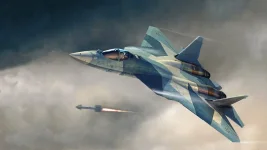
In late May 2026, Russian authorities confirmed that advanced consultations are underway regarding the local co-production of the Su-57E stealth fighter in India.
Despite Moscow’s renewed push to supply the Indian Air Force (IAF) with this fifth-generation aircraft, senior Indian military planners remain deeply apprehensive.
Officials have repeatedly cautioned that purchasing the Russian jet could trigger severe long-term complications, including massive lifetime costs, poor fleet readiness, and direct harm to India's own Advanced Medium Combat Aircraft (AMCA) initiative.
The IAF currently finds itself in a precarious position. Driven by the pressing need to counter regional threats—such as Pakistan's potential acquisition of China's J-35 stealth fighters—India must urgently address its dwindling fighter squadron numbers.
However, military leadership is equally determined to break the historical cycle of relying on imported combat aircraft, especially when the country is heavily funding its own domestic aerospace revolution.
A major worry among defence strategists is the staggering financial burden of operating a highly limited fleet of imported stealth jets.
Analysts note that acquiring just 40 to 60 Su-57s—enough to equip two or three squadrons—would require setting up an entirely separate and costly ecosystem for training, maintenance, and spare parts. Keeping this isolated supply chain running would drastically inflate the financial upkeep of the aircraft over its service life.
Furthermore, there are strong doubts regarding the aircraft's day-to-day operational readiness.
Drawing on decades of complex experiences with Russian-origin fighters, IAF planners are carefully questioning whether the Su-57 can maintain the high serviceability rates required for frontline duty.
In modern aerial warfare, having reliable upgrades, easy access to spares, and dependable aircraft availability is just as vital as the fighter's combat performance.
Financial limitations further complicate the prospect of a Russian import.
India’s defence budget is already stretched across multiple high-stakes modernization projects, including the production of the Tejas Mk1A, the development of the Tejas Mk2, and various advanced drone and missile systems.
Just days ago, the Ministry of Defence moved decisively on the ₹15,000-crore AMCA project by issuing requests for proposals to private domestic consortiums to build the first prototypes.
Squeezing a costly Su-57 acquisition into this packed financial schedule would force difficult compromises.
Aerospace experts and defence critics warn that buying the Su-57 as a temporary fix would steal vital funding, engineering talent, and industrial focus away from the AMCA.
This is a critical moment for India's homegrown stealth jet, which is slated to reveal its first prototype by 2028 or 2029. Any diversion of resources now could severely disrupt the indigenous project's timeline just as it gains crucial momentum.
For its advocates, the AMCA is far more than just a new airplane; it is a foundational pillar for India's technological future.
The project is specifically designed to help domestic industries master complex fields like radar-evading stealth, artificial intelligence, sensor fusion, and indigenous jet engine development.
Undermining this initiative would deal a heavy blow to India's broader goal of becoming a self-reliant aerospace power.
Additionally, experts are deeply sceptical about Russia's capacity to deliver the jets on a reliable schedule.
India previously withdrew from a joint fifth-generation fighter project with Russia in 2018 due to disputes over technology sharing and costs.
Today, with the ongoing war in Ukraine placing immense strain on Russia’s defence factories to meet their own domestic military needs, it is highly questionable whether Moscow can supply the IAF without facing severe production delays.
Despite these overwhelming concerns, some voices within the defence community argue in favour of the Su-57.
They point out that the Russian jet would equip India with an active fifth-generation fighter years before the AMCA enters full service, which is projected for the mid-2030s.
Proponents argue this immediate upgrade is necessary to maintain deterrence as neighbouring rivals rapidly modernize their stealth capabilities.
Ultimately, India’s military planners are facing a critical strategic crossroad.
They must decide whether to purchase a foreign stealth jet to quickly plug a hole in their air defences, or to endure a temporary capability gap while focusing all national resources on cultivating a robust, self-sustaining aerospace industry through the AMCA.
The final decision will define India’s aerial combat strategy for the next several decades.
Choosing the Su-57 brings immediate stealth power but risks deepening foreign reliance and stunting local innovation.
Conversely, staying completely dedicated to the AMCA requires patience, but promises a future where India holds total technological sovereignty and an independent defence sector.