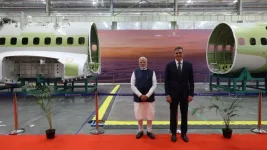
TATA Advanced Systems Limited (TASL) has achieved a major breakthrough in India’s aerospace sector by completing the first Airbus C-295 military transport aircraft at its Final Assembly Line in Vadodara, Gujarat.
This accomplishment is a historic first, as it marks the first occasion a private sector entity in India has successfully built and rolled out a full military aircraft, a domain traditionally led by state-owned enterprises.
Notably, this rollout has been executed months ahead of the original September 2026 deadline.
This event serves as a significant boost to the national 'Make in India' and 'Aatmanirbhar Bharat' campaigns, showcasing the increasing capability of private firms in handling advanced defence projects.
The manufacturing plant in Gujarat was constructed following a ₹21,935 crore contract finalised between the Government of India and Airbus Defence and Space in 2021.
The foundation stone for this facility was laid by Prime Minister Narendra Modi in October 2022.
Specifically procured for the Indian Air Force (IAF), this versatile twin-turboprop aircraft will phase out the legacy Avro HS-748 fleet.
The C-295 is a medium tactical airlifter with a payload capacity of over 9,000 kilograms or up to 71 personnel.
It is engineered to perform diverse roles ranging from transporting troops and freight to executing medical evacuations, disaster relief, and special missions.
Beyond the IAF, the Indian Navy and Coast Guard have also selected maritime surveillance variants of the platform.
According to the 2021 contract, a total of 56 aircraft will be supplied.
The initial 16 units are being built in Seville, Spain, and delivered directly to the IAF in fly-away condition—with six already inducted into the No. 11 Squadron ("Charging Rhinos") stationed in Vadodara.
The subsequent 40 planes are being constructed entirely at the TASL facility, fostering a strong domestic supply chain for defence aviation.
Setting up this assembly line in Gujarat brings vast economic and technological benefits, including significant job creation and the active participation of Micro, Small, and Medium Enterprises (MSMEs).
Currently, over 13,000 distinct components and 4,000 sub-assemblies are being produced locally by 37 identified suppliers, 33 of which are MSMEs.
This initiative ensures vital technology transfer and integrates Indian manufacturers into the broader global aerospace supply network.
Over time, the indigenous content of these aircraft is projected to rise from 48% to nearly 75%.
Furthermore, public sector units Bharat Electronics Limited (BEL) and Bharat Dynamics Limited (BDL) are providing the indigenous Electronic Warfare Suite for the fleet.
The successful completion of this first domestically built unit proves that the collaboration between Tata and Airbus has seamlessly transitioned from building factories to actively delivering flight-ready hardware.
This achievement elevates India into an exclusive group of countries possessing the industrial capacity to assemble modern military transport planes on their own soil.
Widely respected for its operational flexibility, the C-295 can efficiently take off and land on short, rugged, or semi-prepared runways.
This capability is crucial for India’s geographic requirements, allowing the military to reach remote forward bases in mountainous borders and island territories.
Ultimately, the induction of these locally manufactured aircraft will drastically improve the IAF's rapid deployment and overall logistical readiness across all strategic fronts.