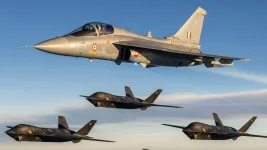
The Defence Research and Development Organisation (DRDO) is shaping India’s Ghatak Unmanned Combat Aerial Vehicle (UCAV) into much more than a standalone stealth bomber.
Rather than operating in isolation, the programme is designed to allow multiple Ghatak aircraft to fly together as a synchronized swarm.
This creates an independent, highly advanced combat network intended to carry out intricate deep-strike operations inside heavily guarded enemy skies.
In a major push for this vision, open-source reports confirm that the Defence Acquisition Council (DAC) recently cleared the procurement of 60 of these advanced drones at an estimated cost of ₹39,000 crores.
Moving away from the traditional idea of drone swarms made up of countless tiny quadcopters, the Ghatak framework envisions several heavy 13-tonne stealth jets operating as one combined force.
Expected to be powered by a dry variant of the indigenous Kaveri engine, each UCAV will boast a substantial weapons payload, cutting-edge sensors, and artificial intelligence, enabling the group to act as a unified, wide-reaching combat system.
Inside this group, artificial intelligence and secure, decentralized data networks will assign mission duties on the fly.
Instead of every drone doing the exact same job, each Ghatak will take on a specific, supporting role while constantly sharing data with the rest of the fleet.
The frontline aircraft in the swarm will act as the eyes of the operation.
Utilising their stealthy flying-wing shape to slip into hostile territory, these sensor-focused drones will locate and map out enemy surface-to-air missiles, radar grids, and command bases.
Their main goal is to build a live picture of the battlefield without putting human pilots in danger.
Other drones in the formation will be dedicated to Electronic Warfare (EW). Instead of packing explosives, these specific UCAVs will use their internal bays to carry powerful electronic jamming equipment.
By collaborating, these EW drones can launch a massive electronic assault across a large area, blinding enemy radars and crippling their air defence networks.
Right behind the sensor and jamming units will be the heavy hitters.
Relying on secure targeting data sent by the forward drones, these strike-focused UCAVs will open their stealthy internal bays to drop precision-guided munitions and cruise missiles on key targets.
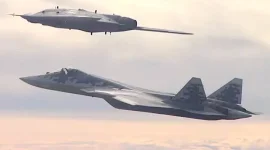
Notably, strategic roadmaps suggest these strike elements may eventually work alongside manned fighter jets like the Tejas and Su-30MKI as part of a broader Manned-Unmanned Teaming (MUM-T) strategy.
Once the targets are hit, any available Ghatak drones will smoothly switch to checking the results of the strike.
Acting as Battle Damage Assessment (BDA) units, they will circle the impact zone to gather high-quality photos and telemetry data to confirm the mission's success before safely leaving the area and sending the information back to friendly forces.
Making this futuristic teamwork possible requires a foundation of highly complex technologies.
A key breakthrough is the use of decentralized software algorithms. This means the swarm does not rely on a single central command drone.
If one aircraft is shot down or loses its signal, the computers on the remaining drones instantly reassign tasks using edge computing, ensuring the mission continues flawlessly.
Furthermore, the drones will rely on anti-jamming mesh networks to communicate.
By using focused, hard-to-detect radio frequency signals, the aircraft can share data directly with one another.
This removes the need for constant satellite connections, making the swarm much harder to defeat in environments where the enemy is actively trying to block communications.
Finally, the system features lightning-fast automated collision avoidance.
Flying multiple stealth jets close together at high tactical speeds requires split-second adjustments.
Advanced onboard computers will constantly recalculate flight routes, adjust spacing, and maintain the formation far quicker than a human pilot ever could.
Following the successful test flights of its precursor, the SWiFT technology demonstrator, the Ghatak programme is steadily advancing toward completely redefining India’s aerial defence capabilities.