- Views: 3K
- Replies: 10
Hindustan Aeronautics Limited (HAL) recently shared an encouraging status report regarding India's upcoming next-generation fighter, the Light Combat Aircraft (LCA) Mk2.
Assembly work on the initial prototype is moving forward smoothly, putting the jet on track to complete its much-anticipated first flight during the window of March to July 2027.
During an interaction with FlightGlobal at the 2026 Farnborough International Airshow, Ravi Kumar, the Chairman and Managing Director of HAL, affirmed that the construction of the primary Tejas Mk2 prototype is adhering to its scheduled roadmap.
Kumar clarified that structural integration is actively ongoing, narrowing down the maiden flight estimate to the mid-2027 timeframe. This update offers the most definitive schedule thus far for the highly anticipated military aerospace initiative.
This projected timeline underscores that the joint efforts of HAL and the Aeronautical Development Agency (ADA) are transitioning from theoretical design confirmation into the vital realm of live flight evaluations.
The introductory prototype will be strictly utilised to verify the jet's aerodynamic stability, propulsion efficiency, integrated avionics, and digital flight control mechanisms. Once these core metrics are proven, further prototypes will be introduced to accelerate the overarching testing cycle.
Rather than just a minor enhancement of the existing Tejas Mk1A, the Mk2—often referred to as a Medium Weight Fighter (MWF)—marks a massive technological evolution.
With an upgraded maximum take-off weight (MTOW) of roughly 17.5 tonnes, the Mk2 is a significantly bulkier and more robust machine.
It has been meticulously crafted to serve as a crucial bridge linking the current light fighters with India’s upcoming fifth-generation Advanced Medium Combat Aircraft (AMCA).
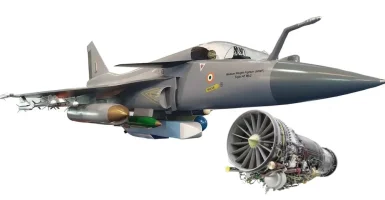
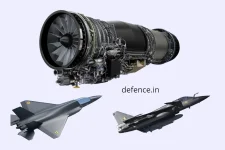
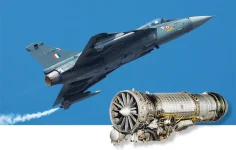
When stacked against its predecessor, the Mk2 boasts an extended airframe and is propelled by the superior GE Aerospace F414-INS6 turbofan engine, which produces around 98 kN of thrust.
This added power facilitates a much higher weapons payload, projected to be around 6,500 kg, alongside a boosted internal fuel capacity of roughly 3,300 kg for an extended combat radius. Furthermore, engineers have prioritised ease of maintenance and overarching operational adaptability.
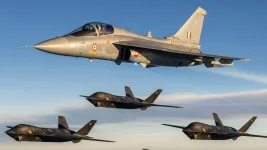
Visually, the most striking alteration is the addition of close-coupled canards located just forward of the primary delta wings.
These aerodynamic surfaces are specifically incorporated to boost the jet's agility, increase aerodynamic lift during steep angles of attack, and balance the flight dynamics of the heavier fuselage.
When paired with the modernised fly-by-wire system, this layout guarantees exceptional mid-air manoeuvrability even when the fighter is loaded with heavy armaments.
Inside the cockpit, the aircraft will be equipped with a cutting-edge suite of domestically produced mission hardware.
Its primary sensor will be the indigenous Uttam Active Electronically Scanned Array (AESA) radar, noted for its superior tracking, long-range detection, and resilience against jamming.
The fighter will also be fortified with a Unified Electronic Warfare Suite (UEWS) and an Infrared Search and Track (IRST) system to silently detect aerial threats.
These systems are bound together by an open-architecture mission computer, allowing for seamless software and hardware upgrades down the line.
The aircraft's offensive punch is similarly receiving a major upgrade. Featuring 11 external hardpoints, the jet is primed to carry a vast arsenal, including the indigenous Astra Mk1 and Mk2 beyond-visual-range missiles, as well as precision smart bombs and anti-radiation weapons like the Rudram series.
This extensive weaponry allows the fighter to execute diverse roles ranging from air dominance and deep-penetration ground attacks to the suppression of enemy air defence networks and naval strikes.
From a strategic standpoint, this platform is vital for the Indian Air Force's long-term planning, particularly given the national push for indigenous defence platforms.
As older squadrons are phased out, the Tejas Mk2 will step in to fill the void, ultimately replacing legacy jets like the Mirage-2000, SEPECAT Jaguar, and MiG-29.
This transition will greatly bolster domestic combat readiness while sharply cutting down India's historical reliance on foreign aerospace acquisitions.
Moreover, the MWF project functions as an essential testbed for the upcoming AMCA fifth-generation stealth fighter.
The advanced technologies currently being perfected on the Mk2—such as complex sensor fusion, next-generation flight control algorithms, and sophisticated electronic warfare modules—will lay the foundation for India's stealth ambitions.
Maturing these systems now drastically lowers the developmental risks for the AMCA, all while granting Indian aerospace scientists invaluable hands-on expertise.
The ongoing assembly of the maiden prototype is a monumental leap, marking the transition from digital blueprints and component testing to the actual physical construction of the fighter.
This rigorous assembly phase entails the meticulous mating of the airframe, the routing of hydraulic and electrical lifelines, the fitting of the landing gear, and the crucial installation of the power plant, setting the stage for the next phase of evaluations.
After the airframe is fully built, the prototype will be subjected to an exhaustive battery of ground-based trials. These will encompass electrical diagnostics, fuel network tests, static engine firings, and high-speed taxi runs to ensure absolute structural integrity prior to flight clearance.
Once it successfully takes to the skies, the testing campaign will scale up swiftly, with subsequent prototypes joining the fleet to validate weapons delivery, expand the flight envelope, and finalise operational doctrine.
While the March to July 2027 bracket has been officially cited for the inaugural flight, the exact day hinges entirely on the flawless execution of the upcoming ground tests and structural integration.
As is standard with complex aerospace ventures, initial flight dates are subject to minor modifications depending on real-time data gathered during assembly, framing HAL’s announcement as a pragmatic goal rather than a rigid, unyielding deadline.