

Member
- Messages
- 2
- Reactions
- 0
- Points
- 1
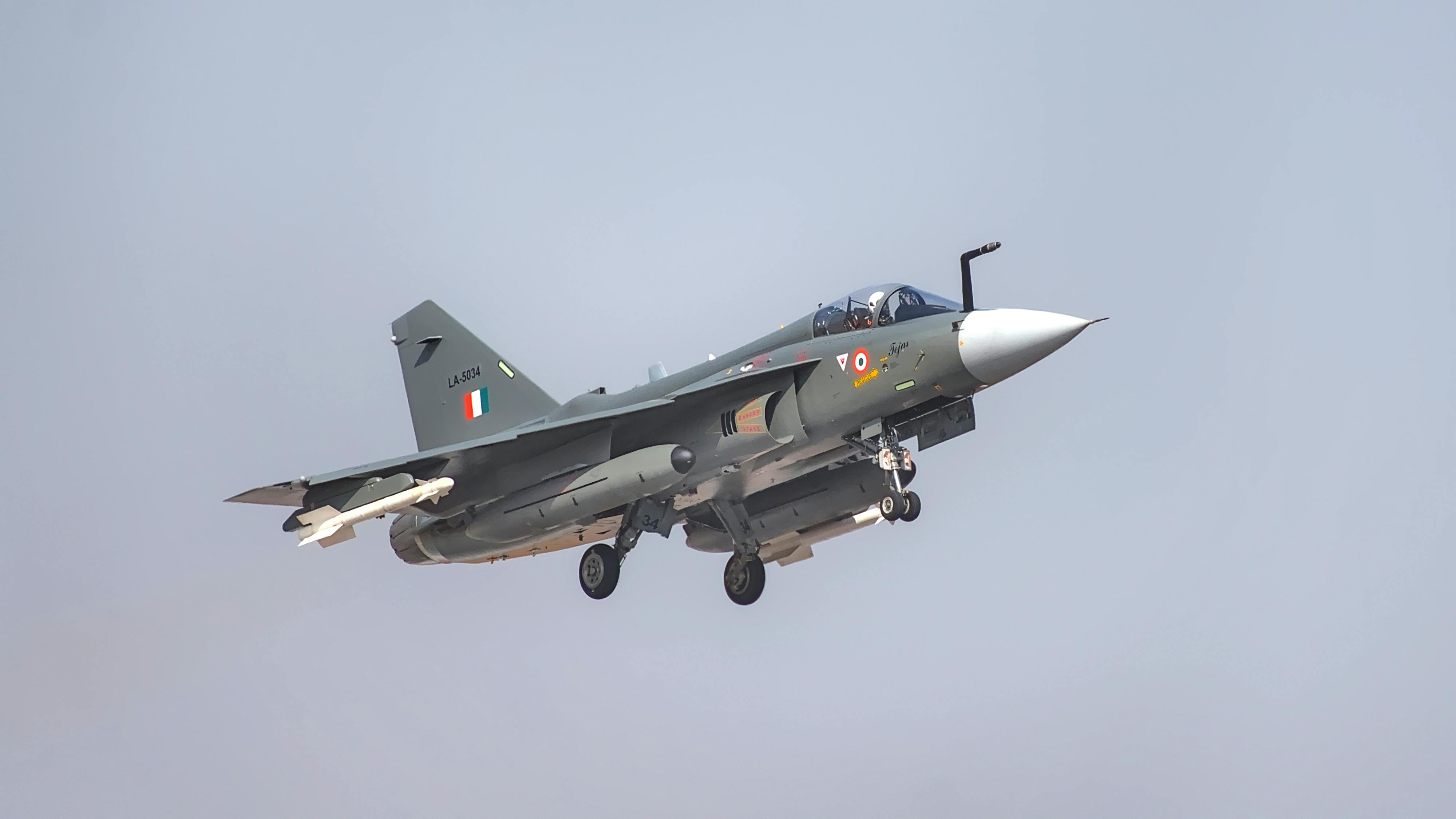
This is an independent academic preprint submitted to AIAA Journal of Propulsion and Power. All values derived from publicly available data using standard aerospace methodology (NASA TM-88273, TM-104329, SAE ARP1420C, Seddon & Goldsmith).
Dedicated to Wing Commander Namansh Syal, who gave his life representing India at the Dubai Airshow, November 21, 2025.
What this paper covers:
- Tejas Mk1 bifurcated lateral inlet DC60 distortion growth under high-AoA and negative-G conditions.
- Fixed splitter plate diverter limitations under off-design attitudes.
- Lumped-parameter thermal accumulation model across the reconstructed display sequence.
- Compressor stall margin degradation (pressure loss + DC60 + thermal effects)
- Mk1A three-door AAID modification as documented evidence of pre-existing Mk1 inlet deficit.
- Three redesign alternatives: DSI, chin/ventral intake, rear-shifted lateral
- Engine: GE F404-GE-IN20 (GE Aerospace)
- Nominal Mass Flow: ~66 kg/s (GE Data Sheet)
- Max Exhaust Temperature: ~2110 K (NASA TM-88273)
- DC60 at high AoA (derived): 0.12–0.15 (This work)
- Mass Flow at 25° AoA (derived): ~42 kg/s (This work)
- Mk1A Pressure Recovery Improvement: +3% (IDRW / HAL)
- F404 Thermal Time Constant: 30–45 s (Kurzke 2018)
Academia: https://www.academia.edu/165616464/...estigation_of_the_2025_Dubai_Airshow_Incident
GitHub: https://github.com/Trigodil/tejas-inlet-analysis
Last edited:


