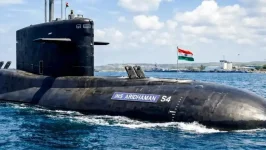
India’s indigenous nuclear-powered attack submarine (SSN) program, known as Project 77 (formerly Project 75 Alpha), is evolving into a significantly more powerful and versatile platform than originally planned.
Following the Cabinet Committee on Security's (CCS) clearance for the construction of the first two vessels at the Shipbuilding Centre (SBC) in Visakhapatnam, the design has shifted.
Rather than a standard hunter-killer submarine, the Navy is now developing a hybrid "arsenal SSN" capable of both stealthy maritime control and heavy long-range strikes against land targets.
Expanded Displacement and Modular Firepower
The most notable evolution in the design is the move toward a massive 10,000-tonne displacement.This increase in size provides the necessary internal volume for a modular Vertical Launch System (VLS), which is expected to house up to 24 cruise missiles.
This upgrade places the Project 77 class in the same league as modern Western and Russian nuclear submarines, which prioritize vertical payload flexibility alongside traditional torpedo-tube armaments.
By utilizing large-diameter "universal" launch cells, the Indian Navy achieves two strategic goals:
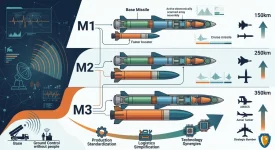
- Mixed Loadouts: The vessels can carry a diverse array of weapons simultaneously, such as the supersonic BrahMos-ER and the long-range Nirbhay/ITCM cruise missiles, which possess ranges exceeding 1,500 km.
- Future-Proofing: This architecture allows the fleet to integrate future missile technologies without requiring expensive and complex structural changes to the submarine's pressure hull.
Integration of Hypersonic Technology
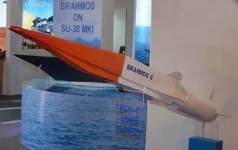
A critical aspect of Project 77 is its built-in compatibility with hypersonic weaponry.By designing the launch systems and electronic fire-control interfaces to support the BrahMos-II class of weapons from the start, the Navy avoids the difficulties associated with retrofitting advanced tech into older ships.
As the Defence Research and Development Organisation (DRDO) matures its hypersonic programs, these submarines will be ready to deploy high-speed strike options with minimal delay.
Advanced Propulsion and Stealth Features
To ensure both speed and silence, the submarines will be powered by a 190–200 MWe pressurized water reactor.This high-output reactor provides the endurance needed for sustained high-speed underwater transit.
Furthermore, the Project 77 boats will utilize pump-jet propulsion instead of traditional propellers.
This technology significantly reduces the submarine’s acoustic signature, making it harder for adversaries to detect.
Additional stealth measures include:
- Raft-mounted internal machinery to dampen vibrations.
- Advanced anechoic coatings to absorb sonar waves.
- Sophisticated quieting technologies to allow operations close to contested coastlines.
Strategic Impact in the Indian Ocean
From an operational standpoint, the 24-cell VLS transforms each submarine into a mobile, flexible strike hub.During peacetime, these vessels will focus on Intelligence, Surveillance, and Reconnaissance (ISR) and tracking foreign naval movements.
In times of crisis or conflict, they provide a "hard-to-detect" platform for launching precision strikes from unpredictable locations, complicating the defence planning of any adversary.
While the design is ambitious, the project faces complex engineering challenges. Integrating a high-performance nuclear reactor and a large VLS while maintaining strict noise-reduction standards requires world-class systems engineering.