- Views: 1K
- Replies: 3
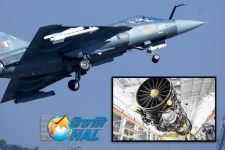
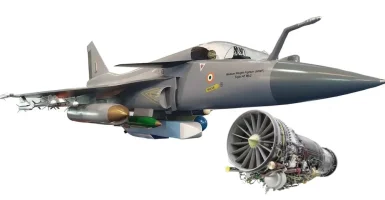
The Hindustan Aeronautics Limited (HAL) Tejas Mk1A is advancing into a critical stage of its weapons testing programme with upcoming flight trials for a dual-missile launcher.
This system is specifically designed to deploy the Advanced Short Range Air-to-Air Missile (ASRAAM).
This milestone represents a major upgrade in the aircraft’s within-visual-range (WVR) dogfighting strength, permitting it to hold more short-range weapons without losing space for other essential payloads.
First unveiled to the public during the Aero India 2025 exhibition, the dual-ASRAAM launcher drew significant interest.
It highlights the Indian Air Force's (IAF) ongoing initiatives to maximise the combat power of the Tejas Mk1A by introducing more intelligent and efficient payload solutions.
This innovative configuration permits a single wing pylon to securely carry two ASRAAM missiles instead of just one.
As a result, the aircraft's short-range firepower is effectively doubled without the need to modify the jet with additional weapon hardpoints.
In active combat scenarios, this setup grants pilots enhanced tactical options.
With a larger stockpile of short-range missiles, the crew can target multiple aerial threats in close quarters.
Meanwhile, the remaining pylons are kept free to carry beyond-visual-range (BVR) missiles, smart bombs, external fuel tanks, or electronic warfare pods.
For lightweight combat aircraft like the Tejas Mk1A, smart payload management is absolutely vital.
It ensures the fighter can adapt to diverse mission profiles while still packing a formidable punch in the air.
Manufactured by MBDA UK, the ASRAAM stands as one of the most sophisticated fifth-generation short-range missiles currently deployed by military forces worldwide.
The weapon is fitted with a highly capable Imaging Infrared (IIR) seeker, which provides outstanding target tracking.
When integrated with a pilot’s Helmet Mounted Display and Sight (HMDS), the missile can lock onto enemy aircraft even at extreme off-boresight angles, meaning the pilot does not need to point the nose of the jet directly at the target before firing.
With its rapid acceleration and cutting-edge seeker technology, the ASRAAM can effectively hunt down highly agile fighter jets, helicopters, unmanned drones, and even cruise missiles.
This gives pilots a distinct advantage during fast-paced aerial combat.
The IAF selected the ASRAAM to be the primary short-range weapon for the Tejas Mk1A fleet, phasing out the older Russian-origin R-73 infrared missiles.
Reports indicate that to support this transition, MBDA UK has been collaborating alongside India's Bharat Dynamics Limited to establish a local assembly line for the missile.
This strategic partnership, coupled with HAL's target to begin delivering the first batch of Tejas Mk1A fighters to the IAF by September 2026, marks a significant step forward for the nation's domestic aerospace defence sector.