Pakistan recently unveiled the Fatah-3, a supersonic cruise missile that represents a significant new challenge to South Asia's security environment.
Defence analysts indicate this weapon is heavily based on China's HD-1 missile family.
Powered by an integrated solid-fuel ramjet engine, the Fatah-3 is capable of reaching terminal speeds between Mach 2.5 and Mach 4 with an estimated range of 290 to 450 kilometres.
By flying close to the terrain and sea surfaces, this manoeuvrable missile aims to evade radar detection, sharply reducing the reaction time for conventional air defence systems.
Despite these advancements across the border, Indian military planners have been proactively upgrading their defensive shields.
Reports show that India’s air defence network—anchored by the S-400 system, known domestically as the "Sudarshan Chakra"—is a highly integrated, multi-layered architecture engineered specifically to neutralise fast-moving, low-flying supersonic threats before they reach their targets.
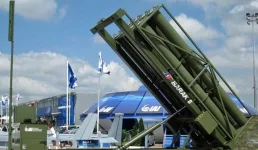
The backbone of this defensive umbrella is the Barak-8 surface-to-air missile, fielded by the Indian armed forces in medium-range (MRSAM) and long-range (LRSAM) configurations.
Created through a joint venture between India's Defence Research and Development Organisation (DRDO) and Israel Aerospace Industries (IAI), the Barak-8 is purpose-built to destroy highly agile supersonic cruise missiles, enemy jets, and sea-skimming anti-ship weapons with an operational range extending up to 100 kilometres.
Experts highlight that the Barak-8 is equipped with specialized technology that makes it uniquely suited to defeat weapons like the Fatah-3.
The most crucial feature is its smokeless dual-pulse solid rocket motor.
While traditional interceptor missiles burn through their fuel immediately after launch, the Barak-8 saves a secondary burst of propulsion for the final moments of its flight.
This terminal energy boost allows the Barak-8 to execute sharp, aggressive manoeuvres to chase down an evasive, weaving target right before impact.
Against a supersonic weapon like the Fatah-3, which may rapidly alter its altitude to confuse interceptors, this retained agility is the difference between a hit and a miss.
Furthermore, the Barak-8 relies on an advanced active radar seeker during the critical end-stage of an engagement. Older defensive missiles depend on ground-based radars to paint the target until the moment of collision.
In contrast, the Barak-8 can lock onto the threat autonomously as it closes in. This independent tracking capability drastically increases the chances of a successful hit against terrain-hugging missiles that might otherwise use the earth's curvature or mountains to hide from ground radar.
The theoretical capabilities of the Barak-8 were reportedly proven in active combat during the India-Pakistan border clashes of Operation Sindoor in May 2025.
Military sources confirm that an Indian Air Force Barak-8 battery, operated by the 45 Wing stationed in Sirsa, successfully shot down an incoming Pakistani ballistic missile—believed to be a Fatah or Shaheen variant—heading toward the National Capital Region.
This real-world interception under immense pressure validated the system's reliability in protecting critical airspace.
To handle sophisticated weapons like the Fatah-3, the Indian military does not rely on just one type of missile. Instead, it utilizes a "Deep Defence" strategy, creating multiple overlapping zones of protection across various altitudes and distances.
At the outermost perimeter lies the Russian-designed S-400 Triumf (Sudarshan).
Capable of engaging targets up to 400 kilometres away, the S-400's powerful panoramic radars provide early warning of a Fatah-3 launch, allowing interceptors to destroy the threat at high altitudes before it descends into lower defensive rings.
If a threat breaches the outer perimeter, the Barak-8 takes over as the primary medium-range defender.
It is guided by the advanced MF-STAR active electronically scanned array (AESA) radar, which provides 360-degree coverage and can track multiple targets simultaneously.
This ensures that even if an adversary launches a saturated attack with several Fatah-3 missiles at once, the Barak-8 batteries can coordinate multiple interceptions without becoming overwhelmed.
Should any missiles slip past the medium-range shield, they encounter the inner defensive rings protected by the indigenous Akash-New Generation (Akash-NG) and the Quick Reaction Surface-to-Air Missile (QRSAM).
These highly mobile systems are engineered for rapid response, designed to shoot down lower-altitude "leakers" that are closing in on vital military assets or civilian centres.
As a last resort, high-value installations and naval warships are guarded by point-defence systems.
These include Very Short Range Surface-to-Air Missiles (VL-SRSAM) and rapid-fire Close-In Weapon Systems (CIWS), which act as a final, localized safety net to destroy any surviving projectiles mere moments before impact.
Ultimately, the true strength of this multi-tiered architecture lies in its seamless digital integration.
Through communication networks like the Integrated Air Command and Control System (IACCS) and the Army’s Akashteer, data from various radar stations and missile batteries are fused into a single real-time picture.
This tri-service coordination ensures that isolated batteries operate as a unified entity, providing an impenetrable countermeasure to emerging supersonic threats in the region.