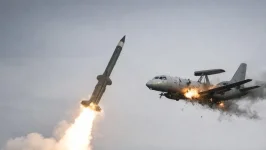
Recent visuals of a People’s Liberation Army Air Force (PLAAF) J-16 fighter armed with an exceptionally high number of air-to-air missiles have drawn attention to China's shifting aerial combat strategy.
By configuring the jet as a dedicated "missile truck," the PLAAF is prioritising the ability to fire massive Beyond-Visual-Range (BVR) missile volleys at multiple targets over carrying traditional ground-strike weapons.
This development prompts a crucial evaluation for the Indian Air Force (IAF): Could India’s frontline Su-30MKI adopt a similar tactical profile through the upcoming Super Sukhoi upgrade? The technical and structural realities suggest it absolutely can, though with distinct operational nuances.
The Chinese "Beast Mode" Doctrine
The Chinese J-16 observed in recent imagery was loaded with long-range PL-15 missiles and shorter-range PL-10 interceptors across nearly all its weapon stations.This heavily armed configuration highlights a doctrine focused on overwhelming adversaries with sheer missile volume, heavily supported by off-board sensors like airborne early warning (AEW) aircraft and secure datalinks.
India’s Su-30MKI is structurally perfectly suited for this role. As one of the world's largest fighter platforms, it boasts a formidable payload capacity of over eight tonnes across 12 hardpoints. This gives the aircraft ample capability to carry a much heavier load of air-to-air weapons than it routinely fields today.
Currently, a standard IAF air superiority patrol might equip the Su-30MKI with a modest mix of Astra Mk-1, R-77, and R-73 missiles, often alongside ground-attack ordnance or the heavy BrahMos cruise missile. Yet, the airframe's robust design allows for a dramatic increase in its dedicated BVR missile inventory.
The Super Sukhoi Upgrade
The sweeping "Super Sukhoi" modernisation programme will make this high-capacity missile concept a reality.A cornerstone of this upgrade is the indigenous Virupaksha Active Electronically Scanned Array (AESA) radar.
Utilizing cutting-edge Gallium Nitride (GaN) technology and approximately 2,400 transmit-receive modules, this advanced sensor will reportedly offer detection ranges approaching 400 kilometres.
This represents a massive leap over the current N011M Bars radar, allowing the aircraft to seamlessly track and engage numerous hostile targets at once.
Explore how the proposed sensor and weapon upgrades affect the Su-30MKI's combat potential:
Key insight: A "missile truck" is only as lethal as its sensors. The transition to the GaN-based Virupaksha radar is what fundamentally enables the Su-30MKI to independently guide multiple long-range weapons simultaneously without relying entirely on ground radar.
Next-Generation Indigenous Firepower
A missile truck requires highly capable weapons, and India's domestic missile programmes are delivering.While the IAF already operates the 100-km range Astra Mk-1, the forthcoming Astra Mk-2 will push engagements past 160 kilometres.
Looking further ahead, the Astra Mk-3, powered by a Solid Fuel Ducted Ramjet (SFDR) engine, is designed to strike targets at hypersonic speeds well beyond 300 kilometres.
By mixing these indigenous long-range weapons with short-range missiles like the ASRAAM or Astra-IR, an upgraded Su-30MKI could easily rival the J-16's air dominance configuration.
Furthermore, the Su-30MKI enjoys distinct engineering benefits. Thanks to its massive twin AL-31FP engines, the heavy fighter can hoist extensive missile payloads without suffering the severe aerodynamic and range penalties that lighter jets face when heavily armed.
Building the Tactical Network
However, fielding a missile truck requires more than just bolting on extra weapons; it demands a sophisticated operational network.The PLAAF’s strategy relies heavily on a comprehensive "kill chain" where targeting data is fed to the J-16 from KJ-500 early warning planes and ground radars, allowing the fighter to launch missiles silently without emitting its own radar signature.
The IAF is aggressively building a comparable architecture. Through the Integrated Air Command and Control System (IACCS), the expanding fleet of Netra AEW&C aircraft, and secure tactical datalinks, India is establishing the distributed targeting network required to support high-density BVR warfare.
To physically accommodate a massive missile loadout, minor hardware adaptations will be necessary. Just as China engineered compact dual-launch pylons for the J-16, India may need to design and certify new ejector racks to maximize the Su-30MKI’s carriage capacity without causing drag issues.
Strategic Shifts
Tactically, the IAF has historically favoured multirole flexibility, tasking a single Su-30MKI with both air-to-air and ground-strike duties in a single sortie. In contrast, China appears to be assigning specialised, dedicated roles to its J-16s.Nevertheless, the dense threat environment along India’s northern borders—characterised by enemy drones, cruise missiles, and fighters—could make dedicated, heavily armed combat patrols highly advantageous for the IAF.
The Super Sukhoi initiative also paves the way for further domestic innovation. Indian defence engineers could develop lightweight missile variants or specialised conformal carriage systems, ensuring the Sukhoi can haul maximum firepower while maintaining peak aerodynamic efficiency.
Ultimately, simply counting missiles is not the sole metric of air superiority. Success in modern BVR combat requires superior radar fidelity, robust electronic warfare defences, and seamless network integration.
By investing in the powerful Virupaksha AESA radar and the next-generation Astra missile family, India is ensuring that its Su-30MKI fleet will not only match the capacity of rival missile trucks but possess the necessary technological edge to dominate the skies for decades to come.