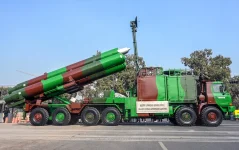
The domestically developed Long-Range Anti-Ship Hypersonic Missile (LR-AShM) is set to emerge as one of India's most powerful naval weapons.
According to Raja Babu, the former Director General of the Defence Research and Development Organisation (DRDO), this advanced system will serve as a massive boost to the nation's tactical strike power.
During his address at the R Defence Forces First Conclave 2026, Raja Babu highlighted the weapon's unique traits.
He explained that the missile's ultra-fast speeds, precise long-distance targeting, and complex flight path will give the Indian Armed Forces a major upper hand in any future sea-based engagements.
The former DRDO chief noted that the LR-AShM launches at a staggering speed of Mach 10 and maintains a speed of around Mach 5 to Mach 6 as it closes in on its target.
With a strike distance of nearly 1,500 kilometres, this extraordinary speed and reach will allow India to neutralise enemy warships from distances well beyond the engagement envelope of traditional anti-ship systems.
"Because of its 1,500-km range and a flight path that is incredibly hard to block, the Long-Range Anti-Ship Hypersonic Missile will multiply the effectiveness of India's tactical strikes," Raja Babu stated at the event.
These insights shed new light on one of the DRDO's most highly anticipated projects. The missile programme is widely expected to heavily upgrade India's ability to restrict enemy movements and deny access across the strategic Indian Ocean Region.
Standard anti-ship missiles generally fly at slower, more predictable speeds. In contrast, hypersonic weapons travel faster than Mach 5, which severely cuts down the time an enemy has to react. Travelling at such intense speeds, the incoming missile gives hostile naval air defence systems very little time to spot, track, and stop the attack.
Intercepting the LR-AShM is made even harder by its unique flight behaviour. Instead of following a steady arc or a straight cruising path, the missile executes complex movements in mid-air. This skipping and dodging makes it incredibly hard for modern missile defence shields to predict where it will be and shoot it down.
This unpredictable movement is a key feature of modern hypersonic technology. It ensures that the weapon can punch through even the most advanced and layered naval defence systems of an adversary.
By hitting targets up to 1,500 kilometres away, the missile greatly widens the area India can protect and control at sea. Indian warships, submarines, and coastal missile batteries armed with the LR-AShM can threaten enemy fleets from a safe distance, remaining completely out of range of older anti-ship weapons.
This massive reach offers India's military planners much more tactical flexibility. They can now target critical enemy assets—such as aircraft carriers—while keeping their own forces safely distanced from direct retaliation.
The blend of sheer speed and vast range will also heavily reinforce India's ability to deter conflicts before they start. In today's naval warfare, destroying enemy ships rapidly before they can even launch an attack is a game-changing advantage, especially in highly disputed waters.
While the former DRDO head did not share specific details about the missile's engines or targeting systems, it is known that India's hypersonic research has been heavily focused on surviving the extreme heat and friction of high-speed flight.
Additional public records reveal that the LR-AShM utilises a two-stage solid rocket motor system carrying a hypersonic glide vehicle (HGV). This vehicle separates and glides unpowered toward its target, using locally developed, high-accuracy sensors for precise final-stage strikes.
The new hypersonic missile will join India's growing arsenal of home-grown, precision-guided weapons.
This includes the famous BrahMos supersonic cruise missile, the Pralay quasi-ballistic missile, and the Rudram anti-radiation missile series. Having all these tools gives Indian commanders a wide variety of attack options for different battlefield situations.
Defence experts consider hypersonic anti-ship missiles crucial in a time when enemy navies use thick layers of missile defence.
By mixing unmatched speed, long-range capabilities, and sharp manoeuvres, these weapons aim to reduce the effectiveness of standard interception methods while guaranteeing a higher chance of destroying heavily guarded naval formations.
Despite these exciting developments, many technical secrets about the LR-AShM are still guarded.
The DRDO has not published full details on its deployment plans or internal technology, although the weapon was recently showcased publicly on a 12x12 mobile launcher at India's 2026 Republic Day parade.
Because of this secrecy, Raja Babu's comments remain among the very few public explanations of how the missile is actually meant to operate.
Ultimately, his statements highlight the DRDO's strong focus on building local hypersonic technology, ensuring India doesn't have to rely on foreign suppliers for advanced arms.
With successful tests of the 12-tonne, 13-metre-long missile having already taken place off the Odisha coast, India's decade-long investment in next-generation flight testing is proving its worth. Hypersonic weapons are now cementing their place as a core pillar of India's long-term defence modernisation strategy.