- Views: 3K
- Replies: 25
With the Defence Research and Development Organisation (DRDO) and the Aeronautical Development Agency (ADA) actively working toward the Tejas Mk2's maiden flight—expected between late 2026 and 2027—India is positioning itself as a serious contender in the global military aerospace sector.
Moving away from the lightweight category of its predecessor, the Tejas Mk1, the upcoming Mk2 is designed as a robust, medium-weight combat jet ready to rival established international fighters like Sweden's Saab Gripen E.
This development aligns perfectly with India's growing focus on defence exports.
Many developing nations in Latin America, Africa, and Asia are currently seeking modern fighter jets that offer high-end capabilities without the massive financial burden of Western fifth-generation stealth jets or the political complications often tied to Russian military hardware.
In this competitive landscape, the Tejas Mk2 is poised to be a highly attractive option.
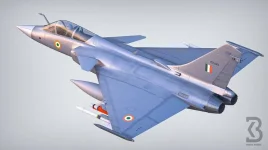
On the surface, the Tejas Mk2 and the Gripen E share several design traits. Both feature a canard-delta wing configuration, which provides excellent agility and high-angle-of-attack performance.
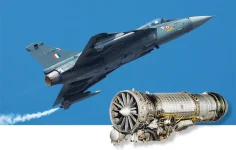
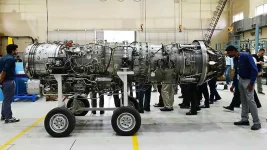
Additionally, both aircraft rely on the same power plant: the General Electric F414 afterburning turbofan engine, which generates roughly 98 kN of thrust. However, their underlying engineering philosophies differ significantly.
The Tejas Mk2 is built to be a heavy-hitting strike aircraft. Its maximum takeoff weight (MTOW) of 17.5 tons represents a major leap from the 13.5-ton Tejas Mk1 and slightly exceeds the Gripen E's 16.5-ton MTOW.
This reinforced structural capacity allows the Indian fighter to carry heavier payloads, stay in the air longer, and execute a wider variety of missions.
When it comes to carrying weapons, the Mk2 is expected to have a distinct edge. The jet will feature 11 hardpoints—one more than the Gripen E—allowing it to carry an impressive 6.5 tons of external stores.
This enables the aircraft to be loaded simultaneously with long-range air-to-air missiles, smart bombs, electronic warfare pods, and external fuel tanks, all while maintaining high operational readiness.
For countries with limited defence budgets, the ability of a single aircraft to perform multiple roles is crucial.
Smaller air forces need jets that can seamlessly switch between air superiority, close air support, and maritime strike missions. The expansive payload capability of the Tejas Mk2 makes it a highly versatile choice for these varied combat scenarios.
A primary concern with the original Tejas Mk1 was its restricted range and flight endurance.
The Mk2 resolves this with a longer 14.6-meter fuselage and a vastly improved internal fuel capacity of approximately 3,400 kilograms. For context, the Gripen E holds about 2,500 kilograms of internal fuel.
This increased fuel volume translates into real-world tactical advantages.
The Tejas Mk2 can patrol for extended periods, execute deep-strike missions, and cover vast maritime zones without constantly relying on mid-air refuelling. Such capabilities are especially valuable for nations with extensive coastlines, remote islands, or limited airbase infrastructure.
Furthermore, the planned addition of Conformal Fuel Tanks (CFTs) will push the jet's endurance even further.
By hugging the aircraft's frame, CFTs carry extra fuel with far less aerodynamic resistance than traditional drop tanks, leaving the wing hardpoints free for more weapons. Paired with the GE F414 engine, this setup will make the Tejas Mk2 highly efficient over long distances.
In the realm of electronics and sensors, Saab’s Gripen E currently holds the advantage of maturity, benefiting from years of NATO integration and a combat-ready Raven AESA radar.
However, the Tejas Mk2 is countering with a fully sovereign Indian digital architecture, which is expected to boast up to 75% indigenous content—a major selling point for export markets.
The Mk2 will be equipped with India's homegrown Uttam AESA radar, which uses advanced Gallium Nitride (GaN) technology for superior target tracking, extended range, and robust resistance to electronic jamming.
Additionally, the cockpit will feature a modern wide-area panoramic display, making it easier for pilots to manage complex combat environments.
For non-aligned countries, this sovereign technology is highly appealing. Purchasing Western combat aircraft often involves strict end-user agreements, software locks, and political scrutiny.
The Tejas Mk2 presents a viable alternative, granting buyers the flexibility to customize their missions and integrate weapons without facing foreign political pressure.
The choice of weaponry further highlights the contrast between the two jets.
The Gripen E is heavily dependent on premium Western munitions like the Meteor and IRIS-T missiles, which can be prohibitively expensive to stock. In contrast, the Tejas Mk2 will be armed with India's growing arsenal of cost-effective, homegrown weapons.
This indigenous weapons package includes the Astra series of beyond-visual-range missiles, Rudram anti-radiation missiles, and precision smart bombs.
Furthermore, the potential integration of the BrahMos-NG supersonic cruise missile would give the Mk2 an unmatched maritime and deep-strike capability in the medium-weight fighter class.
Ultimately, affordability may be the deciding factor for many buyers. While the Gripen E is undeniably a sophisticated and proven platform, its high purchase price and reliance on expensive Western supply chains put it out of reach for many nations.
By positioning the Tejas Mk2 as a budget-friendly jet that still delivers cutting-edge sensors, long-range capabilities, and modern multirole performance, India is offering a compelling package.
The Tejas Mk2 is more than just an upgrade; it marks a pivotal moment for India's aerospace industry. It signals the nation's evolution from building light fighters to producing and exporting highly advanced, medium-weight combat aircraft powered by indigenous technology and mission systems.